Watch Replay: Basin Ventures Q2 Investor Webinar
Watch Now


Website Cookies
This website uses cookies to ensure you get the best experience on our site.


On Friday, October 2, crude oil fell almost 5% in a single morning. Nothing changed about the barrels. Word broke that the Group of Seven would consider releasing up to 100 million barrels of emergency oil and diesel over four months, and the market took the news as if the oil had already arrived.1 By that afternoon it was official: a coordinated release through the IEA, starting immediately, with a front-loaded diesel release in the first 20 days.2 Behind that headline, Washington had told Germany and France to release emergency diesel or face a possible U.S. diesel export ban, reportedly asking for 120 million barrels over six months, ahead of the midterm elections.3 The G7 statement also committed members to refrain from export restrictions on energy among themselves, which took the U.S. threat off the table.4
For a sense of scale: the world uses about 102.6 million barrels of oil a day.5 A 100-million-barrel release is roughly one day of global demand, spread over four months, or about 830,000 barrels a day.6 And it isn't a new commitment. The G7 framed it as helping complete the 426 million barrels members pledged back in March.7 It's the same savings account, drawn faster.
Emergency reserves exist for exactly the kind of disruption we're living through, and using them was the right call. What worries me is what comes after. When the next crisis hits and those reserves are already spent, what happens to the price of oil, and who ends up holding the power?
A strategic reserve is a country's savings account for oil. The U.S. Strategic Petroleum Reserve, or SPR, holds crude in underground salt caverns along the Gulf Coast. Every member of the International Energy Agency (IEA), which includes the U.S., Europe, Japan and Korea, is required to keep stocks equal to at least 90 days of its net oil imports and to be ready to release them together in an emergency.8
Since the war began in late February, the savings accounts have been drawn hard:
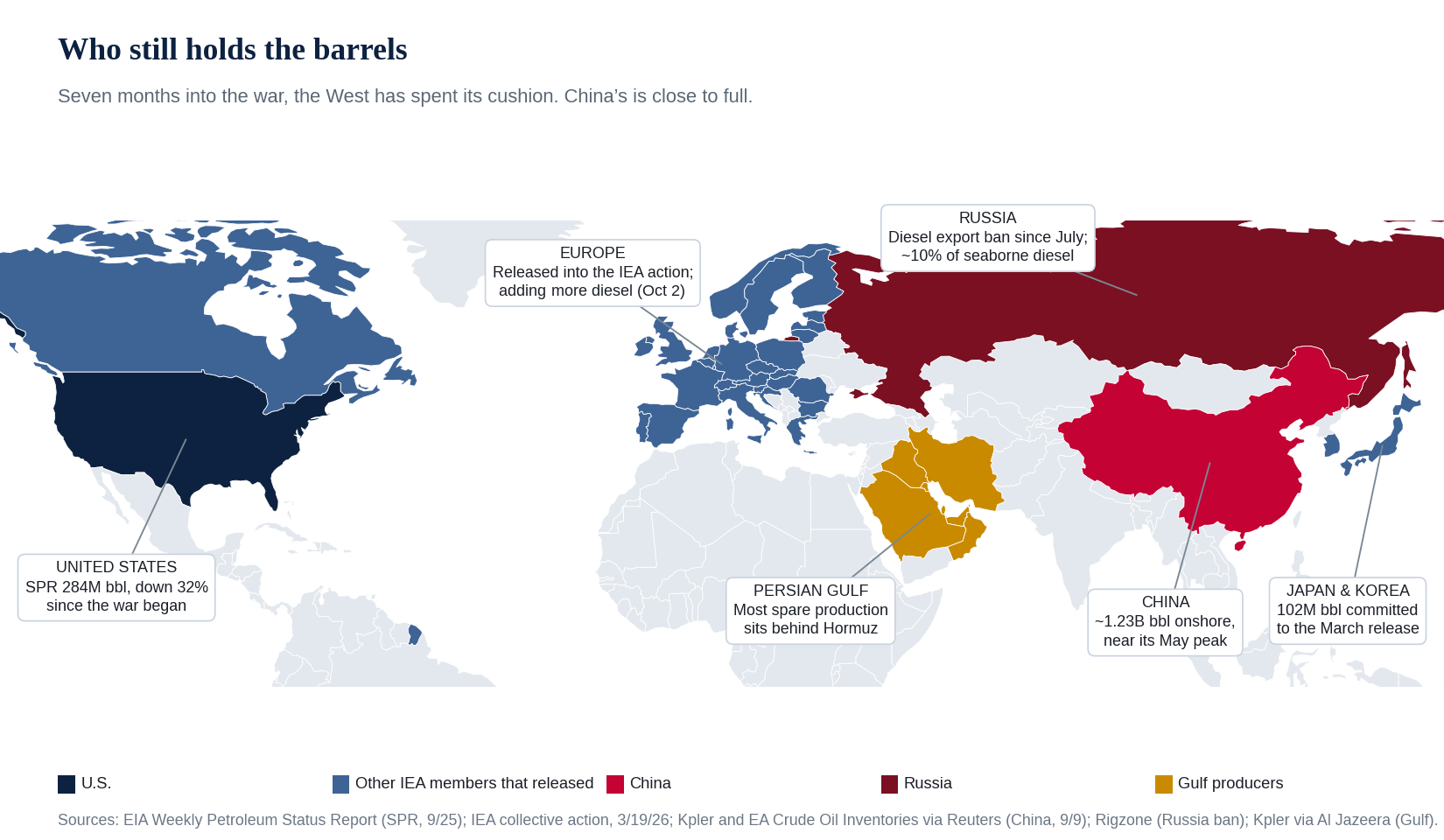
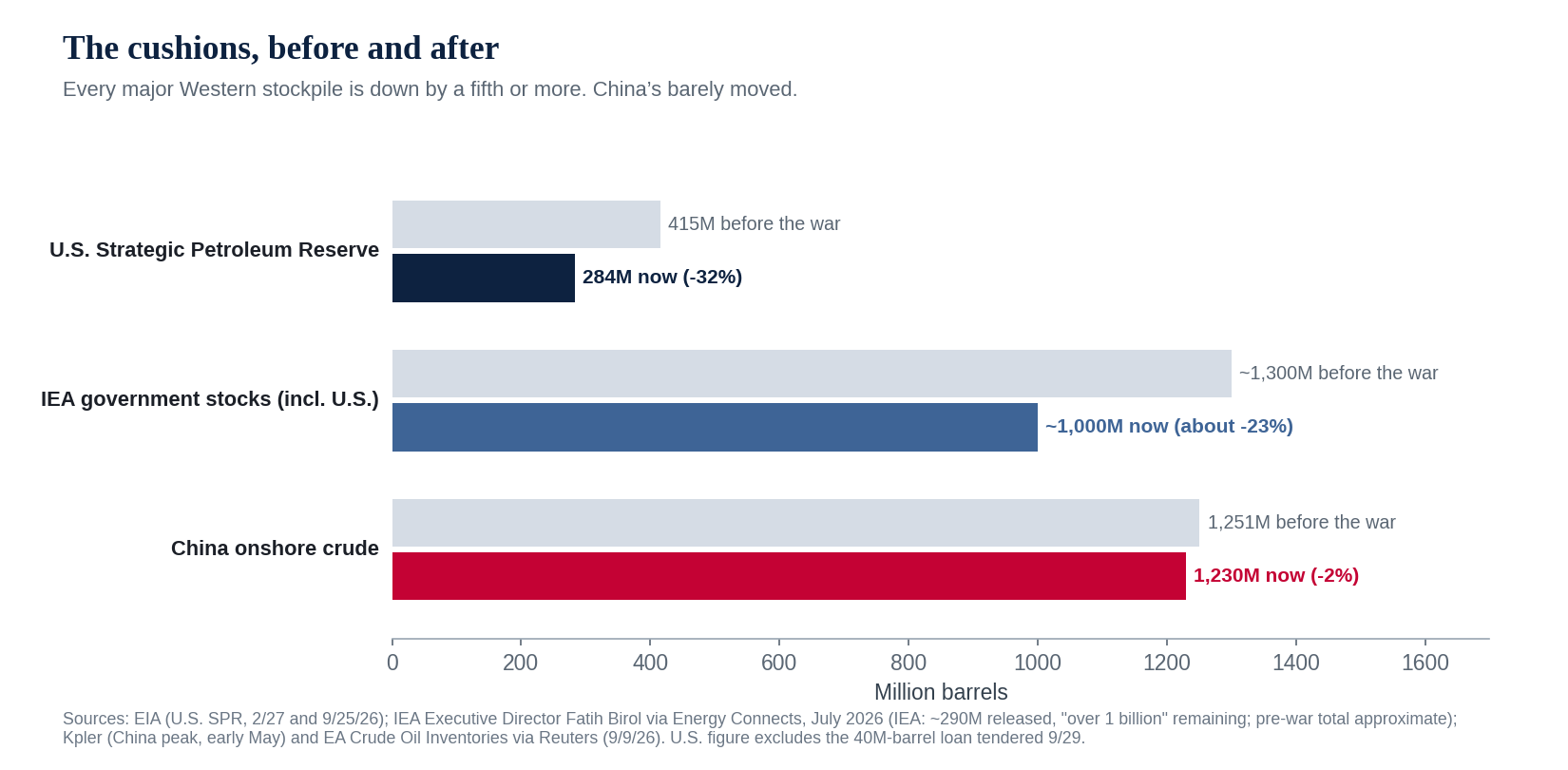
The reserves did their job, which was to buy time. Middle East crude production that was shut in averaged 5.0 million barrels a day in July and 6.7 million in August.5 Worldwide, oil inventories fell by an average of 3.9 million barrels a day in the second quarter and 3.0 million in the third.5 Strategic reserves were a big part of that cushion.
Even with that help, physical Brent crude went from $71.32 the day before the war to a high of $138.21 on April 7, and averaged about $96 in the third quarter.15 In mid-September, physical cargoes traded more than $20 a barrel above the futures price most people see on television.16 That's the price of oil you can actually load onto a ship.
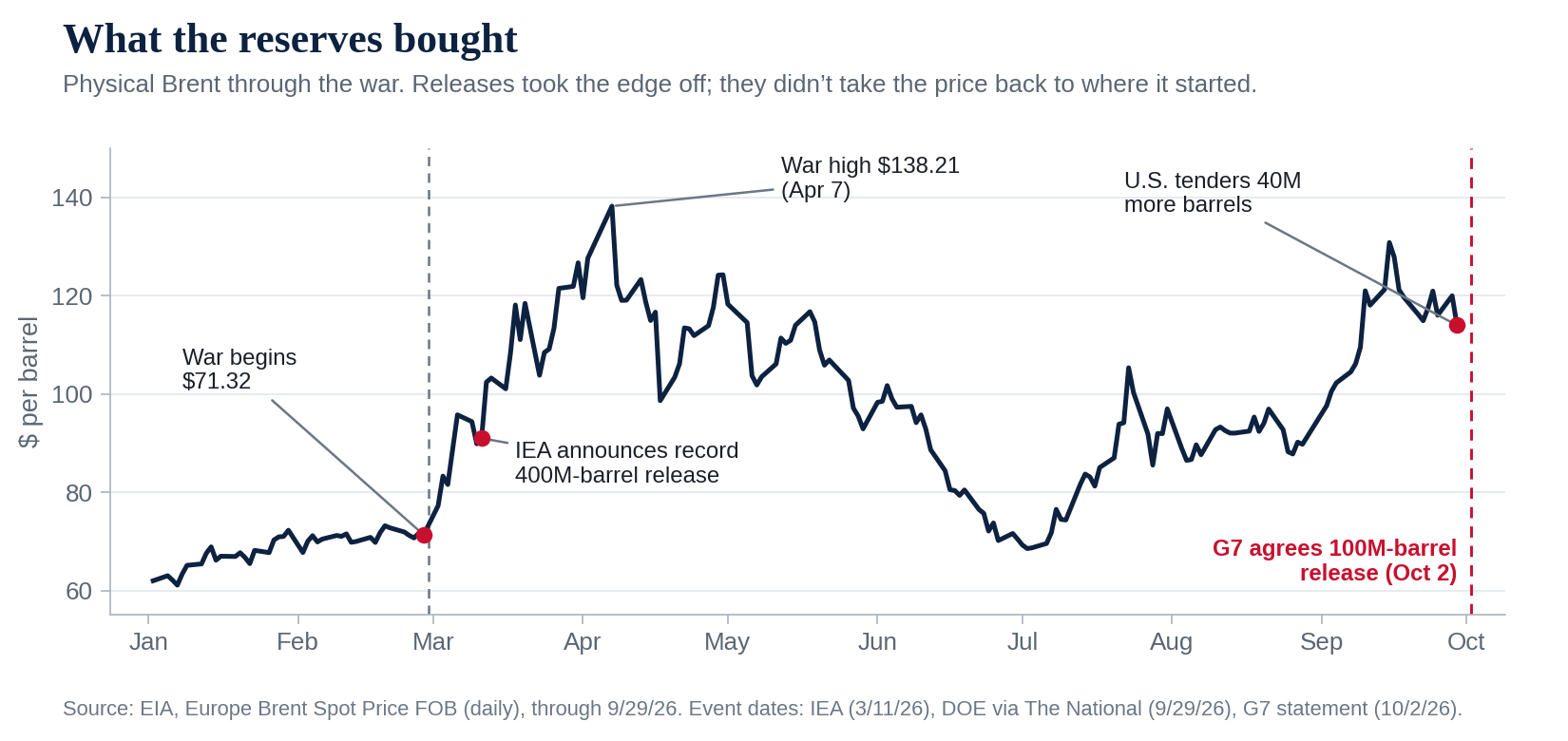
Seven months in, we've used that time to manage the price. We haven't used it to build supply, refining capacity or a plan to refill what we've drawn.
When supply is suddenly short and there's no stockpile to fill the gap, only one thing can balance the market: price. It has to rise until enough people drive less, ship less and buy less that demand matches the oil that's actually available. Economists measure how sensitive supply and demand are to price with a number called elasticity. In the short run oil is famously insensitive. People still need to get to work, and new wells take months.
The most widely cited recent estimate puts the short-run supply and demand elasticities at about 0.1 each, or 0.22 combined.17 Other published estimates for the first month after a shock run lower, which means bigger price moves.18 We use 0.22 as the "typical" case and 0.10 as the "stressed" case. The math is simple: take the barrels that stockpiles can't cover, express them as a share of world demand, and calculate how far price has to rise to cut that much demand. We start from $77, EIA's Brent forecast for the second quarter of 2027.5
Before trusting it, we checked it against this year. Run with the stock draws the world actually had, the math gives $91 to $110 for an August-sized disruption. Brent's actual third-quarter average was about $96. For a disruption the size of this spring's, when Middle East output was down more than 11 million barrels a day,19 it gives $105 to $154. The actual second-quarter average was about $103, with a high of $138.15 The method lines up with what the market did.
A note on what this is. Treat these numbers as stress tests that show scale. Short-run elasticities overstate how long a spike lasts, because demand and supply both adjust over months. The math also leaves out rerouted shipments, a possible recession and producer responses. What it does show is the order of magnitude: how much work price has to do when the cushion is gone.
Suppose the U.S., Europe, Japan and Korea keep drawing down to manage prices, as they are being pushed to do right now, and China keeps its tanks close to full. Then the next disruption hits. Assume commercial inventories can cover about 1.5 million barrels a day, roughly what they've managed this year, and Western governments have nothing left to add.
From there, the price depends on a decision made in Beijing:
That gap, as much as $38 a barrel in a severe shock, is decided by a government that doesn't share our interests. Meanwhile Russia, which supplied about 10% of the world's seaborne diesel before banning most diesel exports in July, controls the spigot on the fuel that's tightest right now.20 And most of the world's spare production capacity sits behind the Strait of Hormuz, the very place the next disruption is most likely to start.19
In this scenario, the West's emergency plan becomes a phone call to Beijing. That's the opposite of energy dominance.
For most of my life, the rival on the other side of the board was the Soviet Union, and then Russia. Today it's China, and Washington isn't the only capital that sees it that way. China's own neighbors in Asia watch Beijing as closely as we do.
Beijing has already shown us how it uses leverage when it has it. In 2010, during a dispute over islands in the East China Sea, it suspended rare earth exports to Japan, which relied on China for more than 90% of its supply. In 2023, after U.S. chip restrictions, it put gallium and germanium under export licenses and later banned them to the United States. In April 2025, in response to tariffs, it choked off rare earth magnets, approving roughly a quarter of license applications, and Ford temporarily halted a plant in Chicago.21 Those are metals. Picture the same playbook run with oil and diesel. We got a small preview last week. As Europe scrambled for diesel, China canceled some of its October fuel export loadings.4
Energy has been used this way before. In 1973, Arab producers embargoed the United States over military aid to Israel, and oil nearly quadrupled, from $2.90 to $11.65 a barrel.22 In 2022, Russia shut off the Nord Stream pipeline, and the Kremlin said gas would come back when Europe lifted its sanctions.23 Each time, the country holding the energy was trying to change a decision made in someone else's capital.
Now imagine a world where China has all the energy it needs and everyone else is short. Beijing gets a vote on every decision that matters: trade, sanctions, Taiwan, which countries get diesel this winter and which don't. You don't have to fire a shot when you're holding the fuel the other side needs to heat homes and move food. The American-led coalition of free nations, in the West and in the East, would be negotiating from the back of the line.
Rome fed its cities with grain from North Africa. When the Vandals took Carthage in 439, the Western Empire lost the grain and tax revenue it depended on, and within 40 years it was gone.24 Energy is our grain. If the American-led world spends its reserves to win a news cycle and leaves Beijing holding the barrels, I think that's how the American century ends: the way Rome's did, with a supply line someone else controls.
Now suppose everyone, China included, has drawn down, and governments are trying to refill. Refilling is buying. The U.S. alone has 132 million barrels to replace plus 40 million in loans coming back, and IEA members have released more than 300 million barrels since March.9,10,25 Refill purchases running at 1 million barrels a day would take about a year to work through that, and they'd be landing on the market while it's still fragile. Aramco's CEO put a bigger number on it Monday. Refilling all of the world's inventories, not just government reserves, would add about 2 million barrels a day of demand for 18 months, and could take up to two years even after Hormuz reopens. Of the roughly 6 billion barrels still sitting in storage worldwide, he said as much as 90% isn't practically available, because it has to stay in pipelines and tank bottoms for the system to work.26
With no strategic stocks to release and 1 million barrels a day of refill buying still underway, an August-sized shock takes Brent to $101 to $141. A spring-sized shock takes it to $123 to $214.
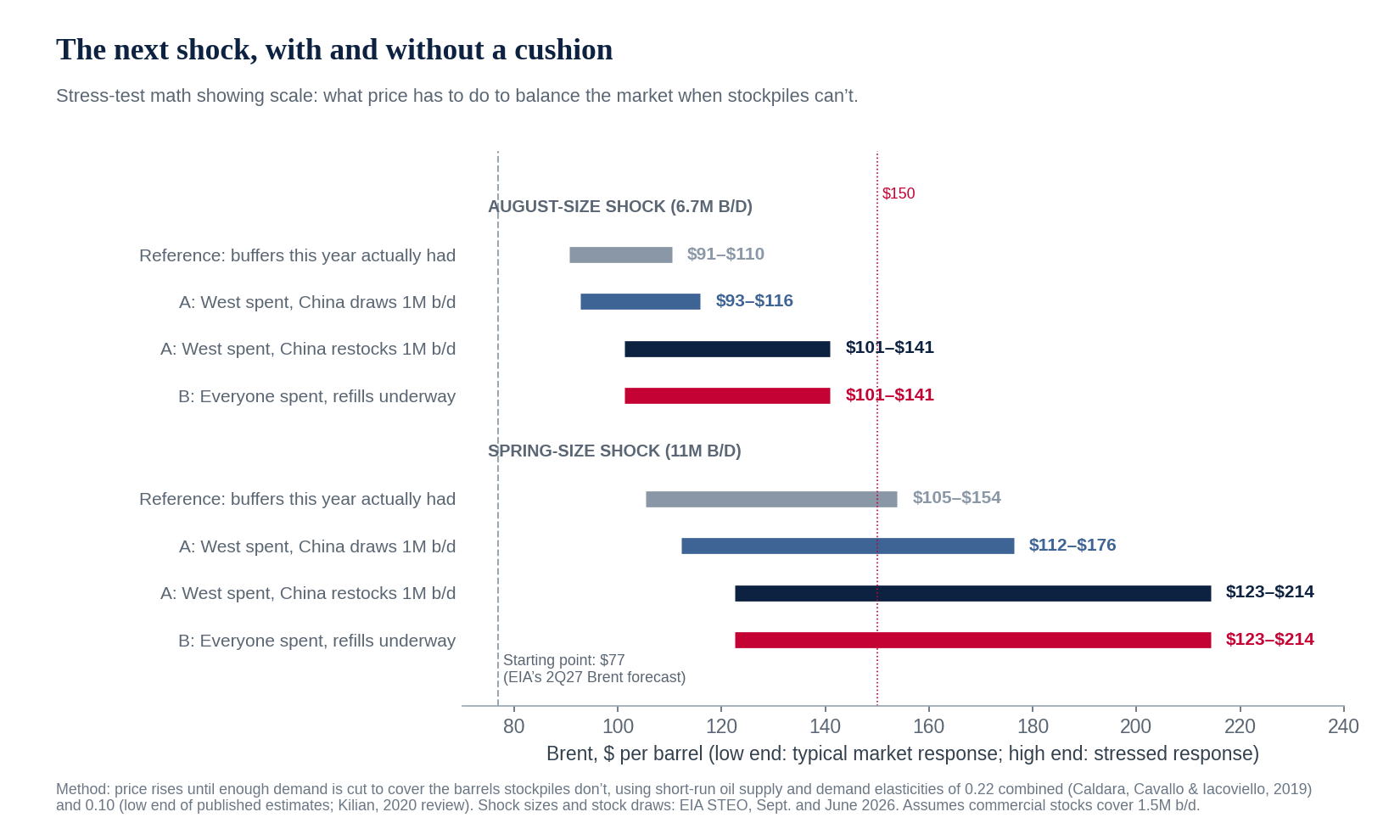
Notice that Scenario B and the "China restocks" version of Scenario A produce the same numbers. If Beijing chooses to rebuild its own stockpile during the next crisis, the West is in Scenario B whether it planned for it or not.
Another disruption is coming. The Strait of Hormuz, the Red Sea, Russian refineries and the Gulf's pipelines have all been hit in the last seven months. The only real debate is timing. As this piece went to publish, Iran said the Strait of Hormuz stays closed until its seven conditions are met,27 the President's national security team spent Friday at Camp David on Iran and Yemen while the Pentagon readied a third aircraft carrier strike group,28 and Saudi-backed forces opened a major offensive against the Houthis in Yemen.29 The Houthis answered with strikes on Aramco sites in Riyadh and at Khurais, where Bangladesh says one of its citizens was killed,30 and on Monday reports conflicted on whether Saudi Arabia's East-West pipeline had been knocked offline again.31
Reserves buy time. Only supply ends a shortage. When prices rise, drilling programs get funded, rigs go to work and new barrels arrive. That's how this country got out of every supply shock in my lifetime. I made the case for what Washington should do in The Federalist: stop talking the price down, take the windfall profits tax off the table, stop using the SPR as a price tool and publish a refill plan with fixed-price forward purchases, fix permitting, and write energy purchases into trade deals. Every week we spend managing the headline instead of building supply makes the next crisis more expensive.
Every American household is short energy from the day it's born. You buy fuel, food, freight and electricity, and all of it carries the price of oil. When the cushion is gone, the next spike arrives faster and goes higher, and it lands in every grocery bill and utility statement. I wrote about this in Oil Isn't Inflationary If You Own It. The families who feel a crisis least are the ones who own a piece of the barrels.
About Basin Ventures. Basin Ventures invests alongside established, mostly publicly traded operators in American oil and natural gas wells. Our underwriting uses conservative long-term price assumptions well below the futures strip, so a high-price environment shows up as upside for our investors. To learn more, visit basinventures.com.
I write about supply, demand and energy policy every week. Follow along at @TheTXOilMan on X, Instagram, Facebook and LinkedIn.
Methodology. Price = $77 × e(uncovered shortfall ÷ world demand) ÷ combined elasticity. Combined elasticity = 0.22 (typical) and 0.10 (stressed). Shock sizes: 6.7M b/d (August 2026 shut-ins, EIA) and 11M b/d (spring 2026, EIA). Stockpile cover: this year's actual global draws (3.0M and 3.9M b/d, EIA) for the reference case; 1.5M b/d of commercial stocks plus or minus 1M b/d of Chinese draws, restocking or refill buying for the scenarios. These are illustrative stress tests meant to show scale.



On Friday, October 2, crude oil fell almost 5% in a single morning. Nothing changed about the barrels. Word broke that the Group of Seven would consider releasing up to 100 million barrels of emergency oil and diesel over four months, and the market took the news as if the oil had already arrived.1 By that afternoon it was official: a coordinated release through the IEA, starting immediately, with a front-loaded diesel release in the first 20 days.2 Behind that headline, Washington had told Germany and France to release emergency diesel or face a possible U.S. diesel export ban, reportedly asking for 120 million barrels over six months, ahead of the midterm elections.3 The G7 statement also committed members to refrain from export restrictions on energy among themselves, which took the U.S. threat off the table.4
For a sense of scale: the world uses about 102.6 million barrels of oil a day.5 A 100-million-barrel release is roughly one day of global demand, spread over four months, or about 830,000 barrels a day.6 And it isn't a new commitment. The G7 framed it as helping complete the 426 million barrels members pledged back in March.7 It's the same savings account, drawn faster.
Emergency reserves exist for exactly the kind of disruption we're living through, and using them was the right call. What worries me is what comes after. When the next crisis hits and those reserves are already spent, what happens to the price of oil, and who ends up holding the power?
A strategic reserve is a country's savings account for oil. The U.S. Strategic Petroleum Reserve, or SPR, holds crude in underground salt caverns along the Gulf Coast. Every member of the International Energy Agency (IEA), which includes the U.S., Europe, Japan and Korea, is required to keep stocks equal to at least 90 days of its net oil imports and to be ready to release them together in an emergency.8
Since the war began in late February, the savings accounts have been drawn hard:
The reserves did their job, which was to buy time. Middle East crude production that was shut in averaged 5.0 million barrels a day in July and 6.7 million in August.5 Worldwide, oil inventories fell by an average of 3.9 million barrels a day in the second quarter and 3.0 million in the third.5 Strategic reserves were a big part of that cushion.
Even with that help, physical Brent crude went from $71.32 the day before the war to a high of $138.21 on April 7, and averaged about $96 in the third quarter.15 In mid-September, physical cargoes traded more than $20 a barrel above the futures price most people see on television.16 That's the price of oil you can actually load onto a ship.
Seven months in, we've used that time to manage the price. We haven't used it to build supply, refining capacity or a plan to refill what we've drawn.
When supply is suddenly short and there's no stockpile to fill the gap, only one thing can balance the market: price. It has to rise until enough people drive less, ship less and buy less that demand matches the oil that's actually available. Economists measure how sensitive supply and demand are to price with a number called elasticity. In the short run oil is famously insensitive. People still need to get to work, and new wells take months.
The most widely cited recent estimate puts the short-run supply and demand elasticities at about 0.1 each, or 0.22 combined.17 Other published estimates for the first month after a shock run lower, which means bigger price moves.18 We use 0.22 as the "typical" case and 0.10 as the "stressed" case. The math is simple: take the barrels that stockpiles can't cover, express them as a share of world demand, and calculate how far price has to rise to cut that much demand. We start from $77, EIA's Brent forecast for the second quarter of 2027.5
Before trusting it, we checked it against this year. Run with the stock draws the world actually had, the math gives $91 to $110 for an August-sized disruption. Brent's actual third-quarter average was about $96. For a disruption the size of this spring's, when Middle East output was down more than 11 million barrels a day,19 it gives $105 to $154. The actual second-quarter average was about $103, with a high of $138.15 The method lines up with what the market did.
A note on what this is. Treat these numbers as stress tests that show scale. Short-run elasticities overstate how long a spike lasts, because demand and supply both adjust over months. The math also leaves out rerouted shipments, a possible recession and producer responses. What it does show is the order of magnitude: how much work price has to do when the cushion is gone.
Suppose the U.S., Europe, Japan and Korea keep drawing down to manage prices, as they are being pushed to do right now, and China keeps its tanks close to full. Then the next disruption hits. Assume commercial inventories can cover about 1.5 million barrels a day, roughly what they've managed this year, and Western governments have nothing left to add.
From there, the price depends on a decision made in Beijing:
That gap, as much as $38 a barrel in a severe shock, is decided by a government that doesn't share our interests. Meanwhile Russia, which supplied about 10% of the world's seaborne diesel before banning most diesel exports in July, controls the spigot on the fuel that's tightest right now.20 And most of the world's spare production capacity sits behind the Strait of Hormuz, the very place the next disruption is most likely to start.19
In this scenario, the West's emergency plan becomes a phone call to Beijing. That's the opposite of energy dominance.
For most of my life, the rival on the other side of the board was the Soviet Union, and then Russia. Today it's China, and Washington isn't the only capital that sees it that way. China's own neighbors in Asia watch Beijing as closely as we do.
Beijing has already shown us how it uses leverage when it has it. In 2010, during a dispute over islands in the East China Sea, it suspended rare earth exports to Japan, which relied on China for more than 90% of its supply. In 2023, after U.S. chip restrictions, it put gallium and germanium under export licenses and later banned them to the United States. In April 2025, in response to tariffs, it choked off rare earth magnets, approving roughly a quarter of license applications, and Ford temporarily halted a plant in Chicago.21 Those are metals. Picture the same playbook run with oil and diesel. We got a small preview last week. As Europe scrambled for diesel, China canceled some of its October fuel export loadings.4
Energy has been used this way before. In 1973, Arab producers embargoed the United States over military aid to Israel, and oil nearly quadrupled, from $2.90 to $11.65 a barrel.22 In 2022, Russia shut off the Nord Stream pipeline, and the Kremlin said gas would come back when Europe lifted its sanctions.23 Each time, the country holding the energy was trying to change a decision made in someone else's capital.
Now imagine a world where China has all the energy it needs and everyone else is short. Beijing gets a vote on every decision that matters: trade, sanctions, Taiwan, which countries get diesel this winter and which don't. You don't have to fire a shot when you're holding the fuel the other side needs to heat homes and move food. The American-led coalition of free nations, in the West and in the East, would be negotiating from the back of the line.
Rome fed its cities with grain from North Africa. When the Vandals took Carthage in 439, the Western Empire lost the grain and tax revenue it depended on, and within 40 years it was gone.24 Energy is our grain. If the American-led world spends its reserves to win a news cycle and leaves Beijing holding the barrels, I think that's how the American century ends: the way Rome's did, with a supply line someone else controls.
Now suppose everyone, China included, has drawn down, and governments are trying to refill. Refilling is buying. The U.S. alone has 132 million barrels to replace plus 40 million in loans coming back, and IEA members have released more than 300 million barrels since March.9,10,25 Refill purchases running at 1 million barrels a day would take about a year to work through that, and they'd be landing on the market while it's still fragile. Aramco's CEO put a bigger number on it Monday. Refilling all of the world's inventories, not just government reserves, would add about 2 million barrels a day of demand for 18 months, and could take up to two years even after Hormuz reopens. Of the roughly 6 billion barrels still sitting in storage worldwide, he said as much as 90% isn't practically available, because it has to stay in pipelines and tank bottoms for the system to work.26
With no strategic stocks to release and 1 million barrels a day of refill buying still underway, an August-sized shock takes Brent to $101 to $141. A spring-sized shock takes it to $123 to $214.
Notice that Scenario B and the "China restocks" version of Scenario A produce the same numbers. If Beijing chooses to rebuild its own stockpile during the next crisis, the West is in Scenario B whether it planned for it or not.
Another disruption is coming. The Strait of Hormuz, the Red Sea, Russian refineries and the Gulf's pipelines have all been hit in the last seven months. The only real debate is timing. As this piece went to publish, Iran said the Strait of Hormuz stays closed until its seven conditions are met,27 the President's national security team spent Friday at Camp David on Iran and Yemen while the Pentagon readied a third aircraft carrier strike group,28 and Saudi-backed forces opened a major offensive against the Houthis in Yemen.29 The Houthis answered with strikes on Aramco sites in Riyadh and at Khurais, where Bangladesh says one of its citizens was killed,30 and on Monday reports conflicted on whether Saudi Arabia's East-West pipeline had been knocked offline again.31
Reserves buy time. Only supply ends a shortage. When prices rise, drilling programs get funded, rigs go to work and new barrels arrive. That's how this country got out of every supply shock in my lifetime. I made the case for what Washington should do in The Federalist: stop talking the price down, take the windfall profits tax off the table, stop using the SPR as a price tool and publish a refill plan with fixed-price forward purchases, fix permitting, and write energy purchases into trade deals. Every week we spend managing the headline instead of building supply makes the next crisis more expensive.
Every American household is short energy from the day it's born. You buy fuel, food, freight and electricity, and all of it carries the price of oil. When the cushion is gone, the next spike arrives faster and goes higher, and it lands in every grocery bill and utility statement. I wrote about this in Oil Isn't Inflationary If You Own It. The families who feel a crisis least are the ones who own a piece of the barrels.
About Basin Ventures. Basin Ventures invests alongside established, mostly publicly traded operators in American oil and natural gas wells. Our underwriting uses conservative long-term price assumptions well below the futures strip, so a high-price environment shows up as upside for our investors. To learn more, visit basinventures.com.
I write about supply, demand and energy policy every week. Follow along at @TheTXOilMan on X, Instagram, Facebook and LinkedIn.
Methodology. Price = $77 × e(uncovered shortfall ÷ world demand) ÷ combined elasticity. Combined elasticity = 0.22 (typical) and 0.10 (stressed). Shock sizes: 6.7M b/d (August 2026 shut-ins, EIA) and 11M b/d (spring 2026, EIA). Stockpile cover: this year's actual global draws (3.0M and 3.9M b/d, EIA) for the reference case; 1.5M b/d of commercial stocks plus or minus 1M b/d of Chinese draws, restocking or refill buying for the scenarios. These are illustrative stress tests meant to show scale.

© Copyright 2026 Basin Ventures II, LLC. All right reserved.