Watch Replay: Basin Ventures Q2 Investor Webinar
Watch Now


Website Cookies
This website uses cookies to ensure you get the best experience on our site.


This morning the national average price of diesel crossed $6 a gallon for the first time in American history. $6.0556, to be exact. AAA now dates the all-time record to today, which is a strange thing to write into a piece you are publishing the same morning.
If you drive a diesel truck, you already knew. If you don't, you will find out in about three weeks, when the cost of moving every product in this country shows up on the shelf.
I want to walk you through what happened this week, because three separate government reports landed inside 24 hours and together they tell a story that most of the coverage has gotten sideways. And then I want to make an argument about what an ordinary person is supposed to do about it.
The short version of that argument is in the title. Let me earn it.
When fuel prices spike, the reflex is to assume we are short of oil.
We are not. Not even a little.
Commercial crude inventories in this country finished the week of September 4 at 424.1 million barrels. That is 0.1% below where they sat a year ago. Call it unchanged. American production touched 13.95 million barrels a day, up 452,000 from last September, which is very close to the most oil this country has ever produced in its history.
So we have plenty of crude and record diesel prices at the same time. Those two facts belong in the same sentence because the bottleneck has moved somewhere most people never think about.
Crude oil is a raw material. Nobody pours it into a tractor. It has to be shipped to a refinery, cooked and separated into gasoline and diesel and jet fuel, shipped again to a terminal, distributed, and finally sold to you. Every one of those steps costs money, and every one of them can break.
Right now the break is in the middle of that chain. And no rig you drop anywhere in Texas reaches it.
Here is what set this week in motion.
OPEC's monthly report put Saudi crude production at 6.2 million barrels a day. That is down 1.9 million, and the lowest the kingdom has produced since 1990. It is the second time this war has walked them to that line. April was the first, when output fell to roughly 6.3 million from 10.88 million in February. Groundhog Day, and nobody is learning anything.
But the headline number is not the interesting part. Which barrels is the interesting part.
Saudi crude gets out of the country two ways. The Red Sea terminals at Yanbu handle the lighter grades. Everything medium and heavy has to run down the Persian Gulf and out through the Strait of Hormuz, and Hormuz has been a shooting gallery since spring. Tanker tracking put Saudi exports down roughly 40% in August. Yanbu alone was down about half from July, and the kingdom has been hauling barrels the long way around through Suez and paying for the privilege.
Now here is the part that connects to your fuel bill.
Not all crude is the same. Light crude yields proportionally more gasoline, naphtha, and jet fuel. Medium and heavy crude yields proportionally more diesel, heating oil, and marine fuel. It is a matter of chemistry, not preference. A refinery configured for heavy sour crude cannot simply decide to run light sweet instead, and the products that come out the other end are determined largely by what went in.
The barrels stranded behind Hormuz are, disproportionately, the diesel barrels.
The world is not just losing oil. It is losing the exact kind of oil that becomes diesel, in the same month that diesel inventories are the thinnest they have ever been for this time of year.
You would think American refiners could make up the difference. They are trying.
Our refineries ran at 98.0% of operable capacity for the week ending August 28, the highest utilization reading since August 2018, and 97.8% the following week. Gulf Coast refineries alone processed 9.7 million barrels a day.
For context, a refinery running above 95% is running hard. 98% is the practical ceiling. You cannot sustain that indefinitely without something breaking, and there is nothing sitting idle waiting to be switched on.
This country has not built a major new refinery from the ground up since 1977. Not an expansion of an existing plant, which we do all the time, but a brand new facility on a new site. Permitting and constructing one takes the better part of a decade. So whatever capacity we have running in September is what we have running through harvest, through heating season, and well into next year. That is the entire list of options.
Meanwhile everybody else's refineries are getting taken apart. Saudi Arabia's Jizan plant, 400,000 barrels a day on the nameplate, was hit September 7 and hit again the next day in a barrage that reached three more cities and put more than 70 people in the hospital. Russia and Ukraine have been trading refinery strikes all year. And the ships carrying finished fuel are running the same gauntlet the crude carriers are.
So the global refining fleet is shrinking while ours runs at the redline. That is not a condition anybody trades their way out of in a quarter.
If you want a single piece of evidence that this is a refining problem and not an oil problem, it showed up on my screen this morning.
Crude rose about 6% across both benchmarks. Brent reached $103.91, WTI $98.70. Heating oil futures, which is how diesel gets priced, rose 5.4% right alongside it.
Gasoline futures fell 3.5%.
Same barrel. Same morning. Two products walking in opposite directions.
Think about what that requires. Gasoline and diesel come out of the same crude oil, refined in the same plants, delivered through the same pipelines. For them to move opposite ways on the same day, something has to be wrong with one and not the other. Light crude and the gasoline it makes are supplied just fine. The medium and heavy grades and the diesel they make are not.
You can see it at the pump too. Diesel is up 63% from a year ago. Gasoline is up 34%, and still sits roughly 14% below its own June 2022 record. Diesel now runs $1.76 a gallon above regular gasoline, which is a spread I have never seen in my career.
Spread across the country it gets stranger. Texas diesel is $5.67. California diesel is $7.98. I am going to let Californians work that one out among themselves.
Two more numbers, and then I will tell you what I think it all means.
The first is distillate, which is the category that includes diesel and heating oil. We finished the week at 106.3 million barrels. That includes a build of 2.1 million on the week, the first relief we have had in a while, and it cuts against everything I just wrote. So let us put it up front rather than bury it in a footnote.
But look at where that sits historically. Over the five years from 2021 through 2025, the lowest this week of the year ever got was 111.8 million barrels. We are below the floor of the five-year range. August bottomed at 103.4 million, the thinnest August in a weekly series that goes back to 1982. And distillate demand is running 3.678 million barrels a day, up 301,000 from a year ago, heading into the season when it always climbs.
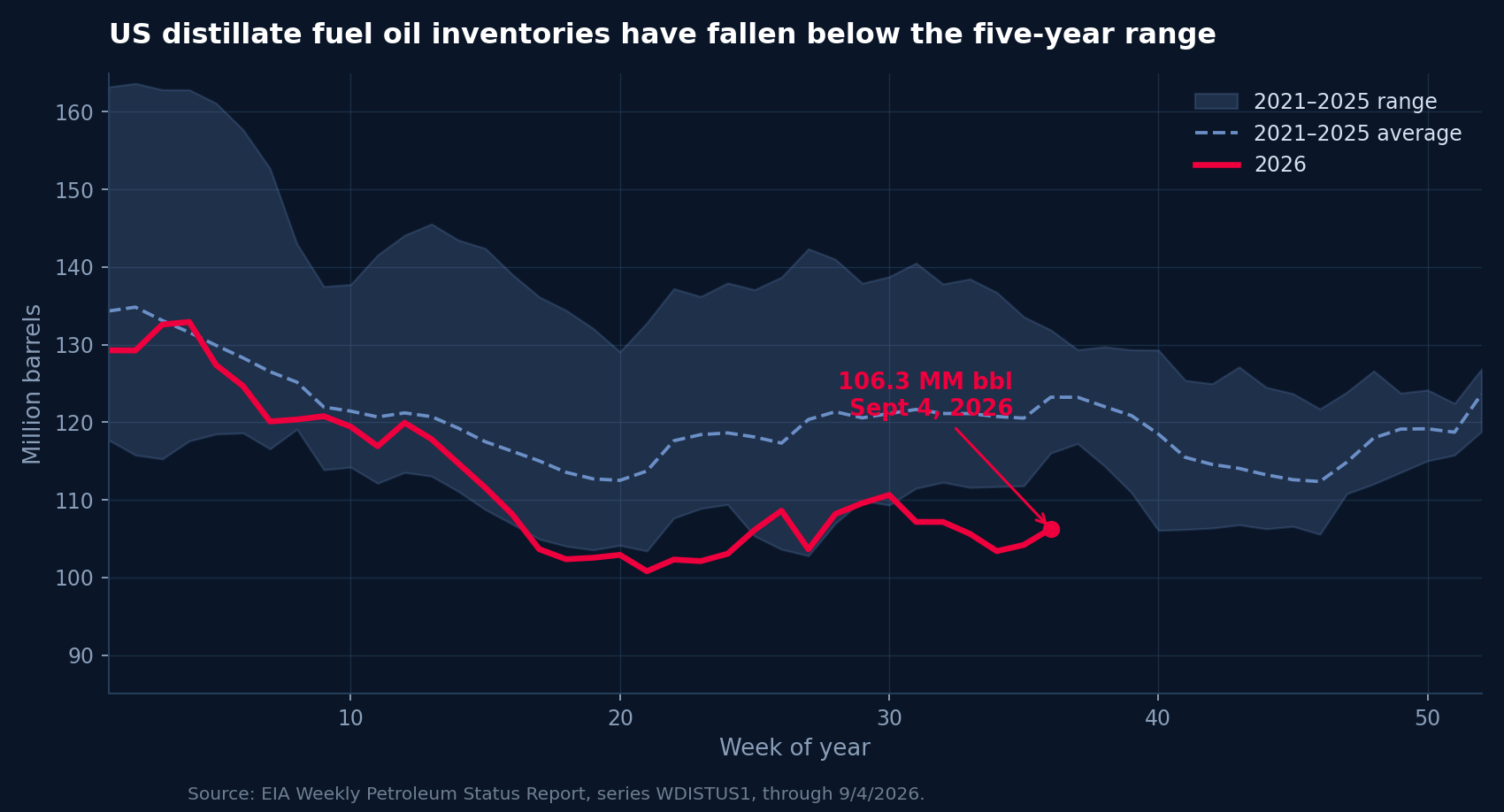
US distillate inventories against the 2021 to 2025 range. The shaded band is the historical range for each week of the year. The red line is 2026, and it has been running underneath the band since spring. Source: EIA Weekly Petroleum Status Report, series WDISTUS1, through September 4, 2026.
The second number is the one I find hardest to look at.
The Strategic Petroleum Reserve is the national emergency stockpile, the salt caverns along the Gulf Coast that exist so this country has a cushion when something goes wrong overseas. It finished the week at 285.4 million barrels. A year ago it held 405.2 million. We are down 119.9 million barrels, or 29.6%, in twelve months.
Set that against commercial crude, which did not move at all.
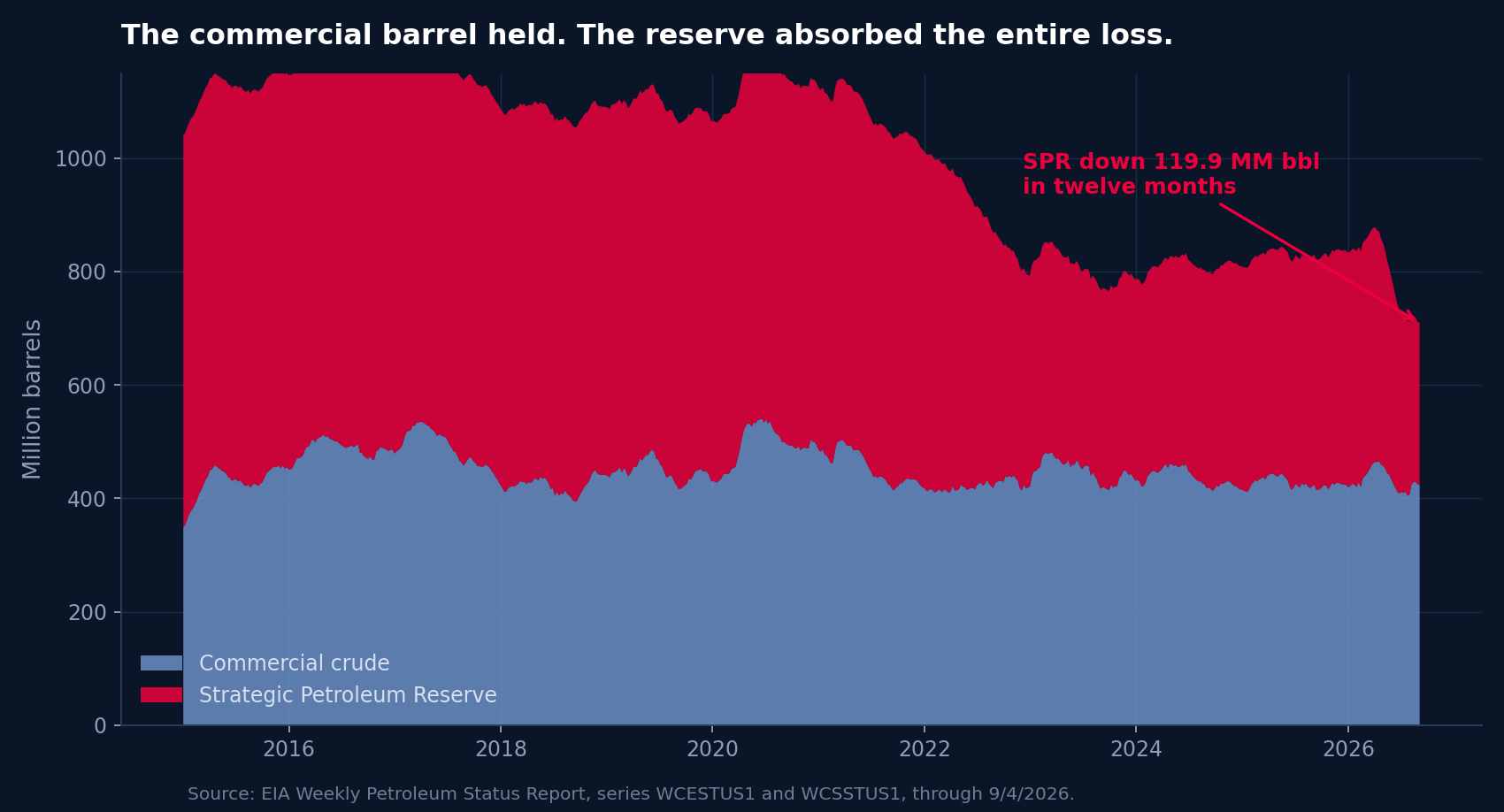
Commercial crude and SPR inventories since 2015. The blue band is working commercial inventory. The red band above it is the emergency reserve. Source: EIA Weekly Petroleum Status Report, series WCESTUS1 and WCSSTUS1, through September 4, 2026.
There is a useful way to think about this called days of cover. Take everything in storage, divide by how much the country burns per day, and you get the number of days the nation could run on what it has. A year ago that figure was roughly 42 days. Today it is about 35.
Every single one of those 7 lost days came out of the emergency reserve. The working commercial barrel never moved.
We did not draw the cushion down because the market ran short. We drew it down because it was the lever we had.
A country can run a thin emergency reserve or it can run a contested supply chain. Running both at the same time is a choice somebody made, and the reserve is down almost 30% while we argue about whose idea it was.
The Energy Information Administration publishes a monthly forecast called the Short-Term Energy Outlook. It is the closest thing this industry has to an official baseline, and it landed Wednesday.
They flagged three notable changes to their forecast this month. Two of the three were diesel.
They raised their 2026 forecast for the distillate crack spread to $1.57 a gallon from $1.30. The crack spread is just the margin between what a refiner pays for crude and what he gets for the diesel he makes out of it, and a rising crack tells you refining capacity is scarce relative to demand. They raised the 2027 number too, from $0.97 to $1.25. They raised expected retail diesel to $5.07 this year and $4.40 next year.
And their forecast now has distillate inventories falling below 100 million barrels this month and staying below the five-year low through much of 2027.
That is the federal government's own baseline putting a two-year clock on this.
I will offer two caveats, as somebody who has been wrong enough in this business to respect anybody willing to publish a forecast with their name attached to it.
EIA finalized their model inputs on September 3 and called Brent around $90 for the back half of this year. Seven days later Saudi output hit a war low and Brent was trading at $103.91. The document says plainly that it does not account for anything after the third... which is the analytical equivalent of a milk carton date, and no fault of theirs. It is the world moving faster than a monthly publication cycle. For what it is worth, the current market-implied crack spread is running near $2.34 a gallon, about 50% above the number EIA had just revised upward two days earlier.
The second caveat matters more for anyone thinking about where this goes. EIA raised its 2027 US production forecast to 14.3 million barrels a day. Meanwhile, through the September 4 count, the US rig count had not budged off 588 for five straight weeks, even as WTI climbed out of the sixties and into the nineties. Their model assumes high prices pull rigs into the field on a predictable lag. Five weeks of a pencil-flat rig line against a 40% move in crude says the field has declined to participate on that schedule.
That gap between what the model expects and what operators are actually doing is one of the more important things happening in this industry right now, and almost nobody is writing about it.
This is where an energy story becomes an everybody story.
Diesel is not a consumer fuel for most people. It is an input cost for the entire physical economy. Trucks, trains, ships, tractors, combines. Harvest season started a few weeks ago. When diesel goes up it does not stay at the pump. It rides through freight rates into the price of every single thing that has to be hauled somewhere before you can buy it.
The August Consumer Price Index came out this morning, and it makes the point better than I can.
Headline inflation rose 0.4% on the month and 3.4% from a year ago. Core inflation, which strips out food and energy to show what the rest of the economy is doing, came in at 2.4%.
Now look inside the number. Gasoline rose 3.9% in August and accounted for more than a third of the entire increase in the index. The broad energy index rose 2.1% on the month and 16.3% from a year ago.
Energy is running nearly 7 times the core rate. And the direction flipped: in July energy was up 14.7% against core of 2.5%. Since then energy sped up and core slowed down. If anybody has told you this round of inflation is broad-based, the Bureau of Labor Statistics respectfully disagrees.
Markets got the message inside of an hour. The odds of a Federal Reserve rate hike at next week's meeting moved to roughly 90% on the release. Which means your mortgage, your car note, and your business line of credit are about to get more expensive because a strait on the other side of the planet is closed.
One note on timing. The August collection period closed before diesel set its record on September 3, and well before it crossed six dollars this morning. None of that is in this report. September will be its own conversation.
Now let me make the argument I actually came here to make.
In markets, being short something means you profit when its price falls and you lose when it rises. Every household in this country is short energy, whether they have ever thought about it in those terms or not.
You buy fuel. You buy electricity. You buy food and goods that were hauled to you on diesel. When energy prices rise, your cost of living rises, and there is no way to opt out of that exposure. You cannot stop driving to work... and the grocery store cannot stop paying its freight bill. That is a position, and almost every American holds it involuntarily, permanently, and on the losing side.
Which brings me to the sentence in the title.
Oil isn't inflationary if you own it.
When you own production, the same price move that raises your cost of living raises your revenue. The exposure that was working against you starts working for you. You go from being structurally short the thing you cannot avoid buying to being flat, or long.
And this matters more with energy than with almost any other hedge, for a reason worth understanding. Most inflation hedges are merely correlated with inflation. Energy is different because energy is a direct input to the index being measured. Gasoline just accounted for over a third of the monthly CPI increase. When you own oil and gas production, your revenue line and the thing driving the inflation number are close to the same variable.
Cash and bonds are nominal claims. They promise you a number of dollars, and the dollar is precisely what is losing purchasing power. A barrel in the ground is a claim on a real good that the world cannot function without, and no central bank has ever created one.
Will somebody pick that apart? Sure. Service costs inflate too, and our cost to drill a well rises alongside the price of what comes out of it. Oil hedges supply-driven inflation better than monetary inflation, and the second half of 2022 showed you can have inflation with falling crude. Producing wells decline over time, so the exposure decays without reinvestment. Those are all true, and anybody selling you an inflation hedge without mentioning them is not being straight with you.
But directionally, for the kind of inflation American households are absorbing right now, the statement holds. This is energy inflation. It is coming from a physical supply problem that the government's own forecast says lasts into 2027. And the people feeling it hardest are the ones with no position on the other side.
I run an oil and gas investment firm, so weigh what follows accordingly. But this is the part where I tell you what we are actually doing rather than just describing the weather.
We have a line we use with investors in our Domestic Development Funds. These funds won't make you rich... but they can sure help you stay rich.
I mean that plainly. If you qualify as an accredited investor in this country, you are almost certainly wealthier than 99% of the people on this planet. The problem in front of you is not getting there. It is staying there while the purchasing power of the dollar you got there with quietly erodes underneath you. Those are different problems and they call for different tools.
Basin Ventures buys non-operated working interests. A working interest is a direct fractional ownership stake in producing wells. Non-operated means we are not the company running the rig and handling day-to-day operations. We underwrite the geology, the operator, and the economics, we write a check for our share of the well, and we receive our share of the revenue and pay our share of the costs. It is direct ownership of production rather than a share of a company that owns production.
The non-operated part is a feature, not a compromise, and it is the piece most people misunderstand at first. We partner with best-in-class operators. Established companies, most of them publicly traded, with names anybody who has spent an afternoon researching this sector would recognize. A fair number of our investors already own their stock in a brokerage account somewhere without having connected the two.
These are the people who are the best in the world at drilling and completing wells. They have the technical teams, the field infrastructure, the service relationships, and the decades of basin-specific data. Our job is not to out-drill them. Our job is to find the right rock with the right operator at the right price and then get out of their way and let them do what they are superb at.
The structural point is the one I made above. Revenue moves with realized wellhead prices rather than with a fixed coupon. That is a description of how the instrument works, not a promise about what it returns.
A few other things about the shape of this asset.
Wells drilled today can produce for decades, which means a position taken now is an exposure that persists long after the news cycle that motivated it has moved on.
And the tax treatment deserves more than a footnote. Intangible drilling costs, which are the labor, fuel, and services that go into drilling a well and typically make up the majority of the cost, have long been deductible in the year they are incurred. What changed with the One Big Beautiful Bill Act is the other half. By making 100% bonus depreciation permanent for property with a recovery period of 20 years or less, the law brought tangible drilling costs, meaning the casing, the wellhead, the tanks and the equipment, into full first-year expensing as well.
Put those two together and a direct participant can potentially offset a very large share of deployed capital against income in year one, while still owning an asset that produces for decades afterward. I am not aware of another place in the tax code that pairs that kind of first-year offset with that kind of asset life. How much any of it matters depends entirely on your own situation, which is a conversation for your tax advisor and not for a blog post.
Our Fund IV closed roughly 60% larger than Fund III, which had itself closed oversubscribed. Fund V is open now and already has assets on the books: a position in the Anadarko producing oil, natural gas, and natural gas liquids, and a position in the Haynesville producing dry gas. We are reviewing projects across the country right now, as we always are, and we intend to be opportunistic as we round out the fund.
That word opportunistic is doing a lot of work in a market like this one. When the whole world is bidding on the same thing at once, discipline matters more than speed. We would rather pass on a deal than pay a war-premium price for it... and we have passed on plenty this year.
Which raises the point I most want understood. We do not underwrite deals to $100 Brent. We never have. Our models are built on conservative long-term price assumptions, well below where the strip sits today, because a fund that only works when the Middle East is on fire is not a fund, it is a bet.
That has a straightforward consequence. When prices run the way they have run this year, the difference between what we underwrote and what the market is paying does not go to us. It goes to the investors in the fund. We built the downside case into the entry price, so a market like this one is a tailwind rather than an assumption we are counting on.
Two things I want understood by anyone evaluating this asset class, including ours. Producing wells decline, so a position has to be replenished to hold its exposure over time. And what a well earns is not the number you see on television. Wellhead realizations differ from the headline benchmark by a basis differential that varies by region, and basis can move against you at the exact moment the front-page number is moving in your favor. Those are features of the asset rather than buried disclosures, and they are the reason operator selection and basin diversification matter more than having a view on price.
None of that makes this a sure thing, and I would be suspicious of anybody who told you otherwise. It makes it a tool with a specific job.
Crude is not the constraint. Our refineries are maxed out, the world's refineries are being destroyed faster than anybody is replacing them, the ships carrying finished fuel cannot move freely, and the specific grades that make diesel are the ones stranded behind a contested strait. The federal government's own forecast says that condition runs into 2027.
More drilling does not fix a refining problem. It never has. We can drill our way out of an oil shortage, but nobody drills their way out of this one.
What that leaves is a simple question about which side of the energy bill you want to be on. Every American is paying it. A much smaller number of Americans own the other half.
Oil isn't inflationary if you own it. That is the whole thesis, and this was the week the data made the case better than I could.
It won't make you rich. It can sure help you stay rich. In a year when energy is running seven times core inflation and the federal government says the squeeze lasts into 2027, that strikes me as the more useful of the two.
I write about this every week. Markets move faster than a monthly blog, so if you want the running commentary, I am @TheTXOilMan on X and Instagram, and Adam W. Butcher on LinkedIn and Facebook. Weekly supply and demand breakdowns on Wednesdays, rig counts on Fridays, and whatever the Middle East does to us in between.
To learn more about Basin Ventures and Fund V, visit basinventures.com.



This morning the national average price of diesel crossed $6 a gallon for the first time in American history. $6.0556, to be exact. AAA now dates the all-time record to today, which is a strange thing to write into a piece you are publishing the same morning.
If you drive a diesel truck, you already knew. If you don't, you will find out in about three weeks, when the cost of moving every product in this country shows up on the shelf.
I want to walk you through what happened this week, because three separate government reports landed inside 24 hours and together they tell a story that most of the coverage has gotten sideways. And then I want to make an argument about what an ordinary person is supposed to do about it.
The short version of that argument is in the title. Let me earn it.
When fuel prices spike, the reflex is to assume we are short of oil.
We are not. Not even a little.
Commercial crude inventories in this country finished the week of September 4 at 424.1 million barrels. That is 0.1% below where they sat a year ago. Call it unchanged. American production touched 13.95 million barrels a day, up 452,000 from last September, which is very close to the most oil this country has ever produced in its history.
So we have plenty of crude and record diesel prices at the same time. Those two facts belong in the same sentence because the bottleneck has moved somewhere most people never think about.
Crude oil is a raw material. Nobody pours it into a tractor. It has to be shipped to a refinery, cooked and separated into gasoline and diesel and jet fuel, shipped again to a terminal, distributed, and finally sold to you. Every one of those steps costs money, and every one of them can break.
Right now the break is in the middle of that chain. And no rig you drop anywhere in Texas reaches it.
Here is what set this week in motion.
OPEC's monthly report put Saudi crude production at 6.2 million barrels a day. That is down 1.9 million, and the lowest the kingdom has produced since 1990. It is the second time this war has walked them to that line. April was the first, when output fell to roughly 6.3 million from 10.88 million in February. Groundhog Day, and nobody is learning anything.
But the headline number is not the interesting part. Which barrels is the interesting part.
Saudi crude gets out of the country two ways. The Red Sea terminals at Yanbu handle the lighter grades. Everything medium and heavy has to run down the Persian Gulf and out through the Strait of Hormuz, and Hormuz has been a shooting gallery since spring. Tanker tracking put Saudi exports down roughly 40% in August. Yanbu alone was down about half from July, and the kingdom has been hauling barrels the long way around through Suez and paying for the privilege.
Now here is the part that connects to your fuel bill.
Not all crude is the same. Light crude yields proportionally more gasoline, naphtha, and jet fuel. Medium and heavy crude yields proportionally more diesel, heating oil, and marine fuel. It is a matter of chemistry, not preference. A refinery configured for heavy sour crude cannot simply decide to run light sweet instead, and the products that come out the other end are determined largely by what went in.
The barrels stranded behind Hormuz are, disproportionately, the diesel barrels.
The world is not just losing oil. It is losing the exact kind of oil that becomes diesel, in the same month that diesel inventories are the thinnest they have ever been for this time of year.
You would think American refiners could make up the difference. They are trying.
Our refineries ran at 98.0% of operable capacity for the week ending August 28, the highest utilization reading since August 2018, and 97.8% the following week. Gulf Coast refineries alone processed 9.7 million barrels a day.
For context, a refinery running above 95% is running hard. 98% is the practical ceiling. You cannot sustain that indefinitely without something breaking, and there is nothing sitting idle waiting to be switched on.
This country has not built a major new refinery from the ground up since 1977. Not an expansion of an existing plant, which we do all the time, but a brand new facility on a new site. Permitting and constructing one takes the better part of a decade. So whatever capacity we have running in September is what we have running through harvest, through heating season, and well into next year. That is the entire list of options.
Meanwhile everybody else's refineries are getting taken apart. Saudi Arabia's Jizan plant, 400,000 barrels a day on the nameplate, was hit September 7 and hit again the next day in a barrage that reached three more cities and put more than 70 people in the hospital. Russia and Ukraine have been trading refinery strikes all year. And the ships carrying finished fuel are running the same gauntlet the crude carriers are.
So the global refining fleet is shrinking while ours runs at the redline. That is not a condition anybody trades their way out of in a quarter.
If you want a single piece of evidence that this is a refining problem and not an oil problem, it showed up on my screen this morning.
Crude rose about 6% across both benchmarks. Brent reached $103.91, WTI $98.70. Heating oil futures, which is how diesel gets priced, rose 5.4% right alongside it.
Gasoline futures fell 3.5%.
Same barrel. Same morning. Two products walking in opposite directions.
Think about what that requires. Gasoline and diesel come out of the same crude oil, refined in the same plants, delivered through the same pipelines. For them to move opposite ways on the same day, something has to be wrong with one and not the other. Light crude and the gasoline it makes are supplied just fine. The medium and heavy grades and the diesel they make are not.
You can see it at the pump too. Diesel is up 63% from a year ago. Gasoline is up 34%, and still sits roughly 14% below its own June 2022 record. Diesel now runs $1.76 a gallon above regular gasoline, which is a spread I have never seen in my career.
Spread across the country it gets stranger. Texas diesel is $5.67. California diesel is $7.98. I am going to let Californians work that one out among themselves.
Two more numbers, and then I will tell you what I think it all means.
The first is distillate, which is the category that includes diesel and heating oil. We finished the week at 106.3 million barrels. That includes a build of 2.1 million on the week, the first relief we have had in a while, and it cuts against everything I just wrote. So let us put it up front rather than bury it in a footnote.
But look at where that sits historically. Over the five years from 2021 through 2025, the lowest this week of the year ever got was 111.8 million barrels. We are below the floor of the five-year range. August bottomed at 103.4 million, the thinnest August in a weekly series that goes back to 1982. And distillate demand is running 3.678 million barrels a day, up 301,000 from a year ago, heading into the season when it always climbs.
US distillate inventories against the 2021 to 2025 range. The shaded band is the historical range for each week of the year. The red line is 2026, and it has been running underneath the band since spring. Source: EIA Weekly Petroleum Status Report, series WDISTUS1, through September 4, 2026.
The second number is the one I find hardest to look at.
The Strategic Petroleum Reserve is the national emergency stockpile, the salt caverns along the Gulf Coast that exist so this country has a cushion when something goes wrong overseas. It finished the week at 285.4 million barrels. A year ago it held 405.2 million. We are down 119.9 million barrels, or 29.6%, in twelve months.
Set that against commercial crude, which did not move at all.
Commercial crude and SPR inventories since 2015. The blue band is working commercial inventory. The red band above it is the emergency reserve. Source: EIA Weekly Petroleum Status Report, series WCESTUS1 and WCSSTUS1, through September 4, 2026.
There is a useful way to think about this called days of cover. Take everything in storage, divide by how much the country burns per day, and you get the number of days the nation could run on what it has. A year ago that figure was roughly 42 days. Today it is about 35.
Every single one of those 7 lost days came out of the emergency reserve. The working commercial barrel never moved.
We did not draw the cushion down because the market ran short. We drew it down because it was the lever we had.
A country can run a thin emergency reserve or it can run a contested supply chain. Running both at the same time is a choice somebody made, and the reserve is down almost 30% while we argue about whose idea it was.
The Energy Information Administration publishes a monthly forecast called the Short-Term Energy Outlook. It is the closest thing this industry has to an official baseline, and it landed Wednesday.
They flagged three notable changes to their forecast this month. Two of the three were diesel.
They raised their 2026 forecast for the distillate crack spread to $1.57 a gallon from $1.30. The crack spread is just the margin between what a refiner pays for crude and what he gets for the diesel he makes out of it, and a rising crack tells you refining capacity is scarce relative to demand. They raised the 2027 number too, from $0.97 to $1.25. They raised expected retail diesel to $5.07 this year and $4.40 next year.
And their forecast now has distillate inventories falling below 100 million barrels this month and staying below the five-year low through much of 2027.
That is the federal government's own baseline putting a two-year clock on this.
I will offer two caveats, as somebody who has been wrong enough in this business to respect anybody willing to publish a forecast with their name attached to it.
EIA finalized their model inputs on September 3 and called Brent around $90 for the back half of this year. Seven days later Saudi output hit a war low and Brent was trading at $103.91. The document says plainly that it does not account for anything after the third... which is the analytical equivalent of a milk carton date, and no fault of theirs. It is the world moving faster than a monthly publication cycle. For what it is worth, the current market-implied crack spread is running near $2.34 a gallon, about 50% above the number EIA had just revised upward two days earlier.
The second caveat matters more for anyone thinking about where this goes. EIA raised its 2027 US production forecast to 14.3 million barrels a day. Meanwhile, through the September 4 count, the US rig count had not budged off 588 for five straight weeks, even as WTI climbed out of the sixties and into the nineties. Their model assumes high prices pull rigs into the field on a predictable lag. Five weeks of a pencil-flat rig line against a 40% move in crude says the field has declined to participate on that schedule.
That gap between what the model expects and what operators are actually doing is one of the more important things happening in this industry right now, and almost nobody is writing about it.
This is where an energy story becomes an everybody story.
Diesel is not a consumer fuel for most people. It is an input cost for the entire physical economy. Trucks, trains, ships, tractors, combines. Harvest season started a few weeks ago. When diesel goes up it does not stay at the pump. It rides through freight rates into the price of every single thing that has to be hauled somewhere before you can buy it.
The August Consumer Price Index came out this morning, and it makes the point better than I can.
Headline inflation rose 0.4% on the month and 3.4% from a year ago. Core inflation, which strips out food and energy to show what the rest of the economy is doing, came in at 2.4%.
Now look inside the number. Gasoline rose 3.9% in August and accounted for more than a third of the entire increase in the index. The broad energy index rose 2.1% on the month and 16.3% from a year ago.
Energy is running nearly 7 times the core rate. And the direction flipped: in July energy was up 14.7% against core of 2.5%. Since then energy sped up and core slowed down. If anybody has told you this round of inflation is broad-based, the Bureau of Labor Statistics respectfully disagrees.
Markets got the message inside of an hour. The odds of a Federal Reserve rate hike at next week's meeting moved to roughly 90% on the release. Which means your mortgage, your car note, and your business line of credit are about to get more expensive because a strait on the other side of the planet is closed.
One note on timing. The August collection period closed before diesel set its record on September 3, and well before it crossed six dollars this morning. None of that is in this report. September will be its own conversation.
Now let me make the argument I actually came here to make.
In markets, being short something means you profit when its price falls and you lose when it rises. Every household in this country is short energy, whether they have ever thought about it in those terms or not.
You buy fuel. You buy electricity. You buy food and goods that were hauled to you on diesel. When energy prices rise, your cost of living rises, and there is no way to opt out of that exposure. You cannot stop driving to work... and the grocery store cannot stop paying its freight bill. That is a position, and almost every American holds it involuntarily, permanently, and on the losing side.
Which brings me to the sentence in the title.
Oil isn't inflationary if you own it.
When you own production, the same price move that raises your cost of living raises your revenue. The exposure that was working against you starts working for you. You go from being structurally short the thing you cannot avoid buying to being flat, or long.
And this matters more with energy than with almost any other hedge, for a reason worth understanding. Most inflation hedges are merely correlated with inflation. Energy is different because energy is a direct input to the index being measured. Gasoline just accounted for over a third of the monthly CPI increase. When you own oil and gas production, your revenue line and the thing driving the inflation number are close to the same variable.
Cash and bonds are nominal claims. They promise you a number of dollars, and the dollar is precisely what is losing purchasing power. A barrel in the ground is a claim on a real good that the world cannot function without, and no central bank has ever created one.
Will somebody pick that apart? Sure. Service costs inflate too, and our cost to drill a well rises alongside the price of what comes out of it. Oil hedges supply-driven inflation better than monetary inflation, and the second half of 2022 showed you can have inflation with falling crude. Producing wells decline over time, so the exposure decays without reinvestment. Those are all true, and anybody selling you an inflation hedge without mentioning them is not being straight with you.
But directionally, for the kind of inflation American households are absorbing right now, the statement holds. This is energy inflation. It is coming from a physical supply problem that the government's own forecast says lasts into 2027. And the people feeling it hardest are the ones with no position on the other side.
I run an oil and gas investment firm, so weigh what follows accordingly. But this is the part where I tell you what we are actually doing rather than just describing the weather.
We have a line we use with investors in our Domestic Development Funds. These funds won't make you rich... but they can sure help you stay rich.
I mean that plainly. If you qualify as an accredited investor in this country, you are almost certainly wealthier than 99% of the people on this planet. The problem in front of you is not getting there. It is staying there while the purchasing power of the dollar you got there with quietly erodes underneath you. Those are different problems and they call for different tools.
Basin Ventures buys non-operated working interests. A working interest is a direct fractional ownership stake in producing wells. Non-operated means we are not the company running the rig and handling day-to-day operations. We underwrite the geology, the operator, and the economics, we write a check for our share of the well, and we receive our share of the revenue and pay our share of the costs. It is direct ownership of production rather than a share of a company that owns production.
The non-operated part is a feature, not a compromise, and it is the piece most people misunderstand at first. We partner with best-in-class operators. Established companies, most of them publicly traded, with names anybody who has spent an afternoon researching this sector would recognize. A fair number of our investors already own their stock in a brokerage account somewhere without having connected the two.
These are the people who are the best in the world at drilling and completing wells. They have the technical teams, the field infrastructure, the service relationships, and the decades of basin-specific data. Our job is not to out-drill them. Our job is to find the right rock with the right operator at the right price and then get out of their way and let them do what they are superb at.
The structural point is the one I made above. Revenue moves with realized wellhead prices rather than with a fixed coupon. That is a description of how the instrument works, not a promise about what it returns.
A few other things about the shape of this asset.
Wells drilled today can produce for decades, which means a position taken now is an exposure that persists long after the news cycle that motivated it has moved on.
And the tax treatment deserves more than a footnote. Intangible drilling costs, which are the labor, fuel, and services that go into drilling a well and typically make up the majority of the cost, have long been deductible in the year they are incurred. What changed with the One Big Beautiful Bill Act is the other half. By making 100% bonus depreciation permanent for property with a recovery period of 20 years or less, the law brought tangible drilling costs, meaning the casing, the wellhead, the tanks and the equipment, into full first-year expensing as well.
Put those two together and a direct participant can potentially offset a very large share of deployed capital against income in year one, while still owning an asset that produces for decades afterward. I am not aware of another place in the tax code that pairs that kind of first-year offset with that kind of asset life. How much any of it matters depends entirely on your own situation, which is a conversation for your tax advisor and not for a blog post.
Our Fund IV closed roughly 60% larger than Fund III, which had itself closed oversubscribed. Fund V is open now and already has assets on the books: a position in the Anadarko producing oil, natural gas, and natural gas liquids, and a position in the Haynesville producing dry gas. We are reviewing projects across the country right now, as we always are, and we intend to be opportunistic as we round out the fund.
That word opportunistic is doing a lot of work in a market like this one. When the whole world is bidding on the same thing at once, discipline matters more than speed. We would rather pass on a deal than pay a war-premium price for it... and we have passed on plenty this year.
Which raises the point I most want understood. We do not underwrite deals to $100 Brent. We never have. Our models are built on conservative long-term price assumptions, well below where the strip sits today, because a fund that only works when the Middle East is on fire is not a fund, it is a bet.
That has a straightforward consequence. When prices run the way they have run this year, the difference between what we underwrote and what the market is paying does not go to us. It goes to the investors in the fund. We built the downside case into the entry price, so a market like this one is a tailwind rather than an assumption we are counting on.
Two things I want understood by anyone evaluating this asset class, including ours. Producing wells decline, so a position has to be replenished to hold its exposure over time. And what a well earns is not the number you see on television. Wellhead realizations differ from the headline benchmark by a basis differential that varies by region, and basis can move against you at the exact moment the front-page number is moving in your favor. Those are features of the asset rather than buried disclosures, and they are the reason operator selection and basin diversification matter more than having a view on price.
None of that makes this a sure thing, and I would be suspicious of anybody who told you otherwise. It makes it a tool with a specific job.
Crude is not the constraint. Our refineries are maxed out, the world's refineries are being destroyed faster than anybody is replacing them, the ships carrying finished fuel cannot move freely, and the specific grades that make diesel are the ones stranded behind a contested strait. The federal government's own forecast says that condition runs into 2027.
More drilling does not fix a refining problem. It never has. We can drill our way out of an oil shortage, but nobody drills their way out of this one.
What that leaves is a simple question about which side of the energy bill you want to be on. Every American is paying it. A much smaller number of Americans own the other half.
Oil isn't inflationary if you own it. That is the whole thesis, and this was the week the data made the case better than I could.
It won't make you rich. It can sure help you stay rich. In a year when energy is running seven times core inflation and the federal government says the squeeze lasts into 2027, that strikes me as the more useful of the two.
I write about this every week. Markets move faster than a monthly blog, so if you want the running commentary, I am @TheTXOilMan on X and Instagram, and Adam W. Butcher on LinkedIn and Facebook. Weekly supply and demand breakdowns on Wednesdays, rig counts on Fridays, and whatever the Middle East does to us in between.
To learn more about Basin Ventures and Fund V, visit basinventures.com.

© Copyright 2026 Basin Ventures II, LLC. All right reserved.