
How a well works

From permit to production: how a well is drilled and completed, why its output declines, what it means to own a non-operated working interest, and how the tax rules for drilling work.

1
Lease and permit
2
Drill
3
Complete
4
Produce
5
Plug and restore

The life of a well

1. Lease and permit

An operator leases the mineral rights in an area, combines them into a drilling unit, and gets a permit from the state regulator. Geologists and engineers choose where to drill based on the rock and on the results of nearby wells.

2. Drill

The rig drills straight down, often more than a mile, then turns and drills horizontally through the target rock, sometimes for two miles or more. Steel casing is cemented into the hole to seal the well off from groundwater.

3. Complete

Crews perforate the casing and pump water and sand at high pressure, in many stages along the horizontal section, to open fractures in the rock. This is hydraulic fracturing. The sand props the fractures open so oil and gas can flow into the well.

4. Produce

Oil, gas and water flow to the surface and are separated. The oil and gas are sold through pipelines or by truck, and the operator measures the volumes and sells them on behalf of all of the well's owners.

5. Plug and restore

When a well's output no longer covers the cost of running it, the well is plugged with cement and the site is restored under state rules.

Why output declines

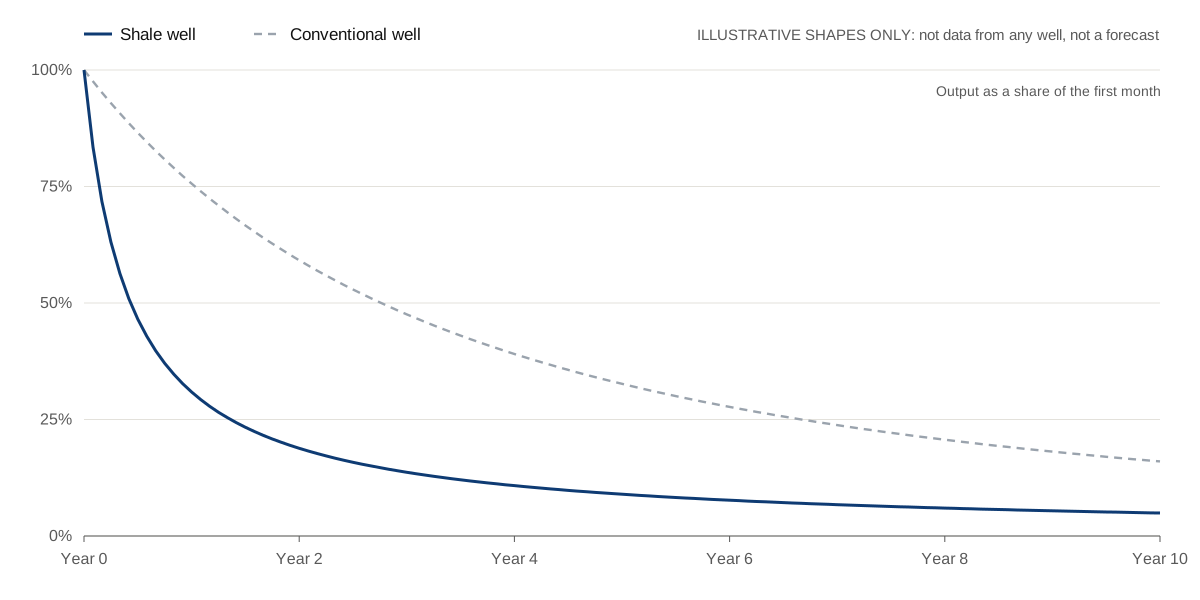
A well produces the most when it is new. As oil and gas flow out, pressure in the rock falls and output declines. Shale wells decline faster than conventional wells: most of their output comes in the first few years, followed by a long, slow tail.

Illustrative chart comparing two decline shapes over ten years: a shale well whose output falls steeply in the first two years and then flattens, and a conventional well that declines more gradually. Not data from any well.
Illustrative shapes only. They show the general pattern of decline, not data from any well and not a forecast for any well. Real wells vary widely, even next door to each other.

Engineers estimate a new well's future output with a type curve: a typical decline pattern built from nearby wells in the same rock. Actual wells can come in above or below it. Because every well declines, the country as a whole has to keep drilling just to hold output steady, as Chapter 2 shows.

Owning a non-operated working interest

A working interest is a share of a well. The owner pays that share of the costs to drill, complete and operate it, and receives that share of the revenue from what it produces. The revenue share is slightly smaller than the cost share, because the royalty owed to the mineral owner comes off the top. That smaller share is called the net revenue interest.

Every well has one operator, the company that runs drilling and day-to-day operations. The other owners are non-operating partners: they put up their share of the capital and receive their share of the revenue without running the field work. The operator bills them each month for their share of costs on a joint interest billing statement, and pays them their share of oil and gas sales.

What can go wrong

  • A dry hole: the well finds too little oil or gas to be worth completing, and its owners still pay their share of the drilling cost.
  • A well that produces less than expected, or declines faster.
  • Cost overruns during drilling or completion, which owners share.
  • Lower oil and gas prices, which reduce revenue from every barrel.
  • Problems with the operator, whose decisions the non-operating partners do not control.

Direct owners are responsible for their share of costs, including overruns, which is one reason many people hold working interests through a fund or company instead. For more, read Non-operated working interests: a beginner's guide and Promoter vs. partner: 8 questions for energy investing.

The tax rules for drilling

Federal tax law treats the cost of drilling a well in a few distinct ways. These are general descriptions, not tax advice: tax benefits depend on individual circumstances and on how an interest is held.

Intangible drilling costs (IDC)

The parts of drilling and completing a well that have no salvage value: labor, rig time, drilling fluids, fuel and similar costs. They are usually the larger share of a new well's cost. A working interest owner may be able to deduct up to 100% of these costs in the year they are incurred. More on intangible drilling costs.

Tangible drilling costs (TDC)

Equipment that has salvage value: casing, the wellhead, tanks and pumps. These costs are not deducted all at once. They are depreciated over several years, and accelerated depreciation may apply.

Depletion

As a well produces, the oil and gas in the ground are used up. The depletion allowance recognizes that. Qualifying independent producers may be able to deduct 15% of the gross income from a property each year, subject to limits on daily production and on taxable income. More on the depletion allowance.

The working interest exception

Income and losses from a working interest held directly, or through an entity that does not limit the owner's liability, are generally not treated as passive under federal rules, so losses may offset other income. Interests held through an entity that does limit liability are usually subject to the ordinary passive activity rules.

Sources and notes

The tax section summarizes Internal Revenue Code sections 263(c) (intangible drilling costs), 168 (depreciation), 613A (percentage depletion) and 469(c)(3) (the working interest exception). It is a general description, not tax advice. Tax benefits depend on individual circumstances; talk with your own tax advisor.

The decline chart is illustrative. It draws two standard hyperbolic decline curves to show the difference in shape between a shale well and a conventional well. It is not fitted to any well, it is not Basin Ventures data, and it is not a forecast.

Written by Basin Ventures. Last updated October 19, 2026.

faq

Questions about wells

How long does a well produce?

Often for decades, at steadily lower rates, until the oil and gas it produces no longer cover the cost of running it. Then it is plugged with cement and the site is restored under state rules.

What is a dry hole?

A well that does not find enough oil or gas to be worth completing. It produces nothing to sell, and its owners still pay their share of what it cost to drill.

What does the operator do?

The operator runs the well for all of its owners: it gets the permits, hires the rig and crews, manages drilling, completion and daily production, sells the oil and gas, pays the bills, and reports to the state and to the other owners.

What is a joint interest billing statement?

The monthly invoice an operator sends to the other working interest owners for their share of a well's costs, from drilling to day-to-day operations. Revenue from oil and gas sales is paid separately, on a revenue statement.

Is this tax advice?

No. The tax section is a general description of federal rules. Whether any of them applies to you depends on your circumstances and how an interest is held, so talk with your own tax advisor.

Back to the guide: Oil & Gas, Explained
Click to Join
Kontix-home-one-marquee-icon-webflow-ecommerce-template
Fund V Has Launched
Secure Your Allocation
Kontix-home-one-marquee-icon-webflow-ecommerce-template
For Accredited Investors
Click to Join
Kontix-home-one-marquee-icon-webflow-ecommerce-template
Fund V Has Launched
Secure Your Allocation
Kontix-home-one-marquee-icon-webflow-ecommerce-template
For Accredited Investors
Click to Join
Kontix-home-one-marquee-icon-webflow-ecommerce-template
Fund V Has Launched
Secure Your Allocation
Kontix-home-one-marquee-icon-webflow-ecommerce-template
For Accredited Investors
Let’s connect

Start earning monthly income now.

Deduct up to 100% of your investment the first year.