Watch Replay: Basin Ventures Q3 Investor Webinar
Watch Now



The short version
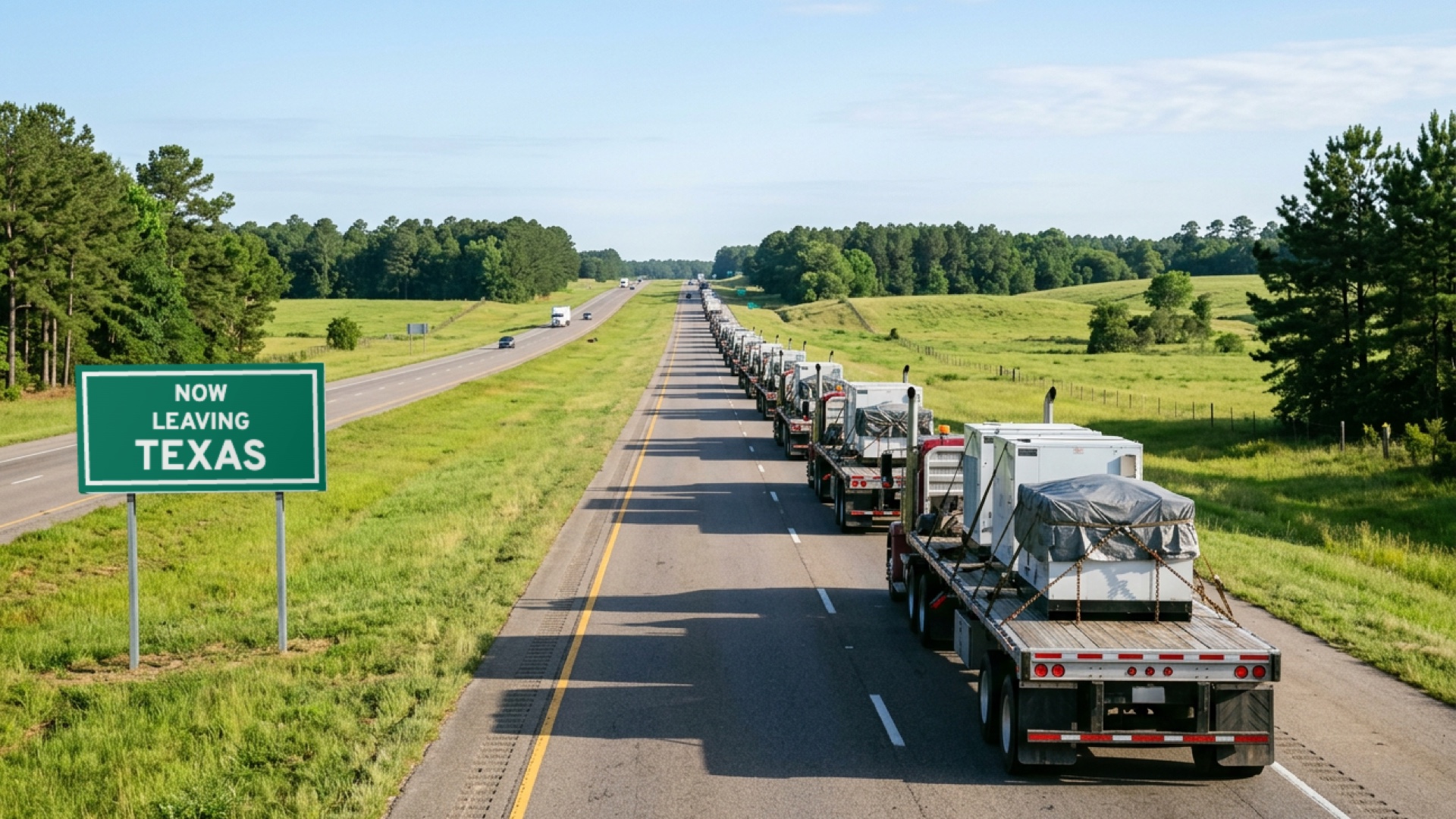
Last week I spent an hour with the Houston Chronicle talking about data centers, and I kept coming back to one idea. Capital goes where it's valued most. A company deciding where to put a $10 billion campus will go where it understands the rules and believes they'll still be the rules when the building is finished. Right now that describes Louisiana and Oklahoma better than it describes Texas.
Both parties made data centers a villain this year, so I'd leave red and blue out of it. A Republican governor stopped the approvals in Texas. A Democrat beat him promising to stop them longer. What a developer sees from the outside is a state where nobody can tell them when the door reopens or what it'll cost to walk through it.
Our gas needs somewhere to go. In Texas and everywhere else, a lot of the gas wells drilled over the past two years were drilled expecting a big new need for the gas, and power for data centers was a large part of that expectation. LNG exports, natural gas chilled to a liquid and shipped overseas, were the other part. Now one of those two buyers isn't sure.
We've seen what happens when gas has nowhere to go. At the Waha hub in West Texas, where Permian gas is priced, gas traded below zero on 134 of 245 trading days between October 2025 and September 2026.1 Most Permian gas comes up alongside oil, so when the pipelines out of the basin filled up, producers would rather pay someone to take the gas than shut in their oil wells. The pipes didn't get any bigger. The negative price decided whose gas got a spot on them, and paid local power plants and storage to take the rest.
More supply is on the way. Enverus expects Haynesville output to reach 18.4 billion cubic feet a day by the end of 2027, and expects new Haynesville supply plus new Permian pipelines to outrun new LNG demand by about 1.3 billion cubic feet a day, leaving the domestic market to soak up the difference.2 Power plants serving data centers were supposed to be a big part of that domestic market.
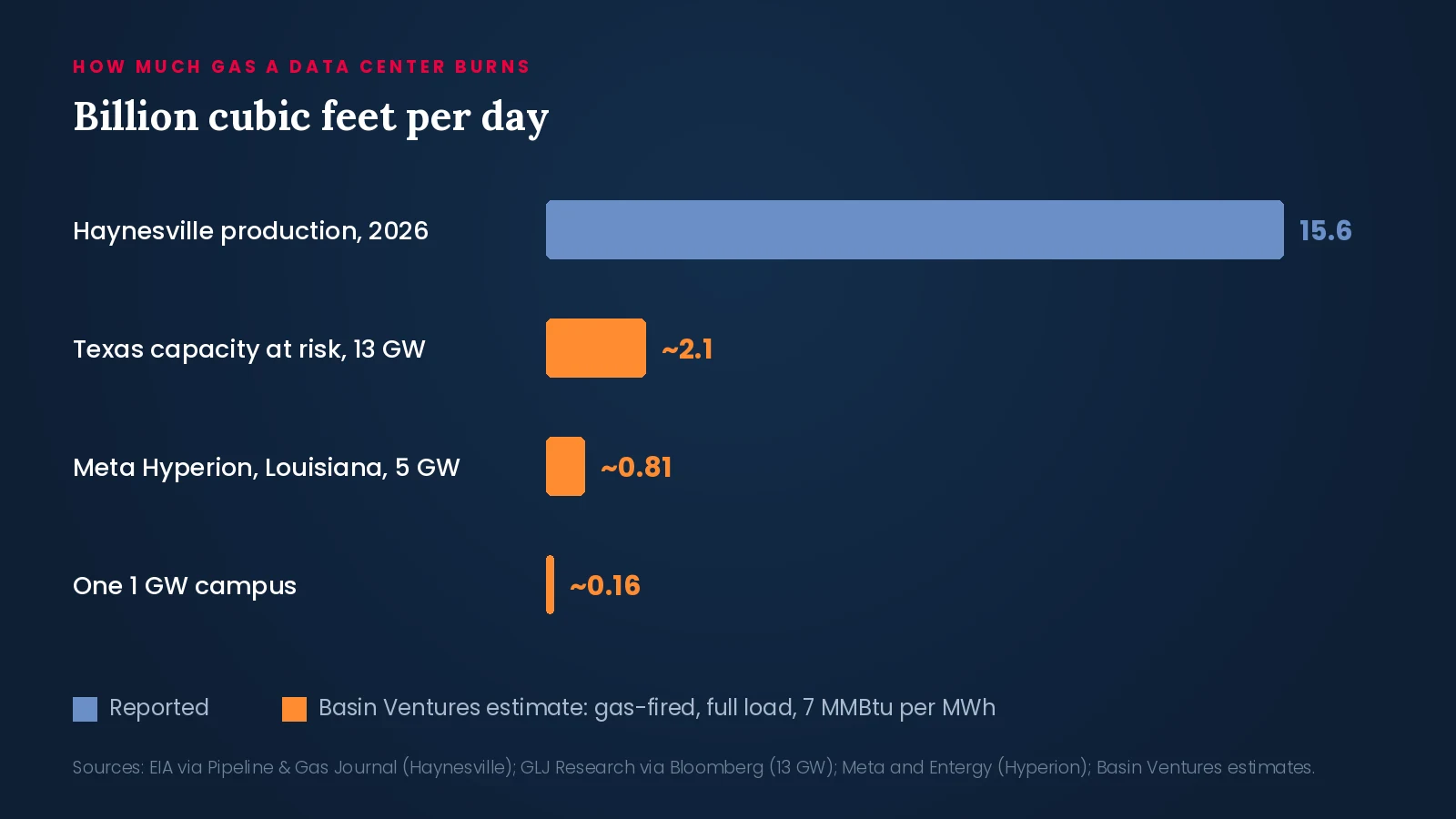
A gas-fired power plant feeding a 1-gigawatt campus around the clock burns about 160 million cubic feet of gas a day (Figure 1). GLJ Research estimates about 13 gigawatts of Texas data center capacity is immediately exposed by the election.3 If all of it ran on gas at full load, that would be about 2.1 billion cubic feet a day, or roughly 13% of what the Haynesville is expected to produce this year.4 That's a ceiling. Not every campus runs on gas, and not every one runs at full load around the clock. LNG is still the bigger buyer today; one estimate puts new data center gas demand this year near 0.5 billion cubic feet a day, against 3.7 for new LNG.5 Data centers were the growth that came next, and gas producers built for it.
On Aug. 3, Gov. Greg Abbott told the state's grid operator, ERCOT, and the Public Utility Commission to stop approving new data center connections until an audit was done. As many as 474 gigawatts of projects were asking to plug into ERCOT, more than five times the grid's all-time demand record.6 On Sept. 21 he went further and told the state environmental agency, TCEQ, to issue no permits for data center projects until they finished the audits.7
Then Gina Hinojosa beat him. During the campaign she promised a moratorium, which she described as a ban, on all data center approvals until the Legislature passes laws to protect Texans. The ERCOT audit is expected in December, the Legislature meets in January, and she takes office Jan. 19. Her message to the industry after the election: "I hate the way they are taking advantage of Texas."8
The tax break is on the table too. Texas exempts qualifying data centers from state sales tax on their equipment and electricity, and the Senate Finance Committee projects that will cost the state about $3.3 billion in the 2028-29 budget.9
Lawmakers didn't wait for January. At least five bills to repeal that exemption were filed on the first day lawmakers could file bills for the 2027 session, and the Senate version from Finance Committee Chair Joan Huffman, a Houston Republican, picked up 23 of the Senate's 31 members and members-elect as authors.10 Three days later SpaceX announced a $24 billion data center at Starbase, and the governor-elect said her moratorium would apply to it like any other.11 Closer to home for us, Fort Worth held its first public hearing Nov. 10 on a 90-day moratorium of its own that it could adopt in February.
Asking data centers to pay for the power plants, wires and water they need is fair. Oklahoma and Louisiana have both written that into their rules, and neither one told the industry to stop while they did it. The trouble in Texas is the open end. A developer ordering turbines and transformers for delivery years from now can price a tariff or a fee. A moratorium with no end date is much harder to price, so the money either waits or goes somewhere it can be put to work.
The projects already underway are safest. Reports indicate projects that already hold permits would be allowed to finish construction.12 That includes some giants: Nexus Hubbard, planned at 6,400 megawatts and meant mostly to serve Anthropic, is under construction in Central Texas.13 GLJ's Gordon Johnson sorted the rest into tiers. Projects with power, permits and steel keep going. Projects with power but no state environmental permits slip 12 to 18 months. And he wrote that projects with neither "probably go to Louisiana, Oklahoma or nowhere."3
Developers told the Chronicle the same thing in their own words. Some said they're committed to staying in Texas, and others said they'd look at more welcoming states.14 Texas holds about a quarter of the planned data center capacity in the U.S., according to Goldman Sachs,15 and Cleanview counts about 40% of pending U.S. capacity in states where newly elected governors promised to stop or pause construction.16 When that much of the pipeline is in question at once, the states that say yes get a long look.
My read on what's likely in Texas:
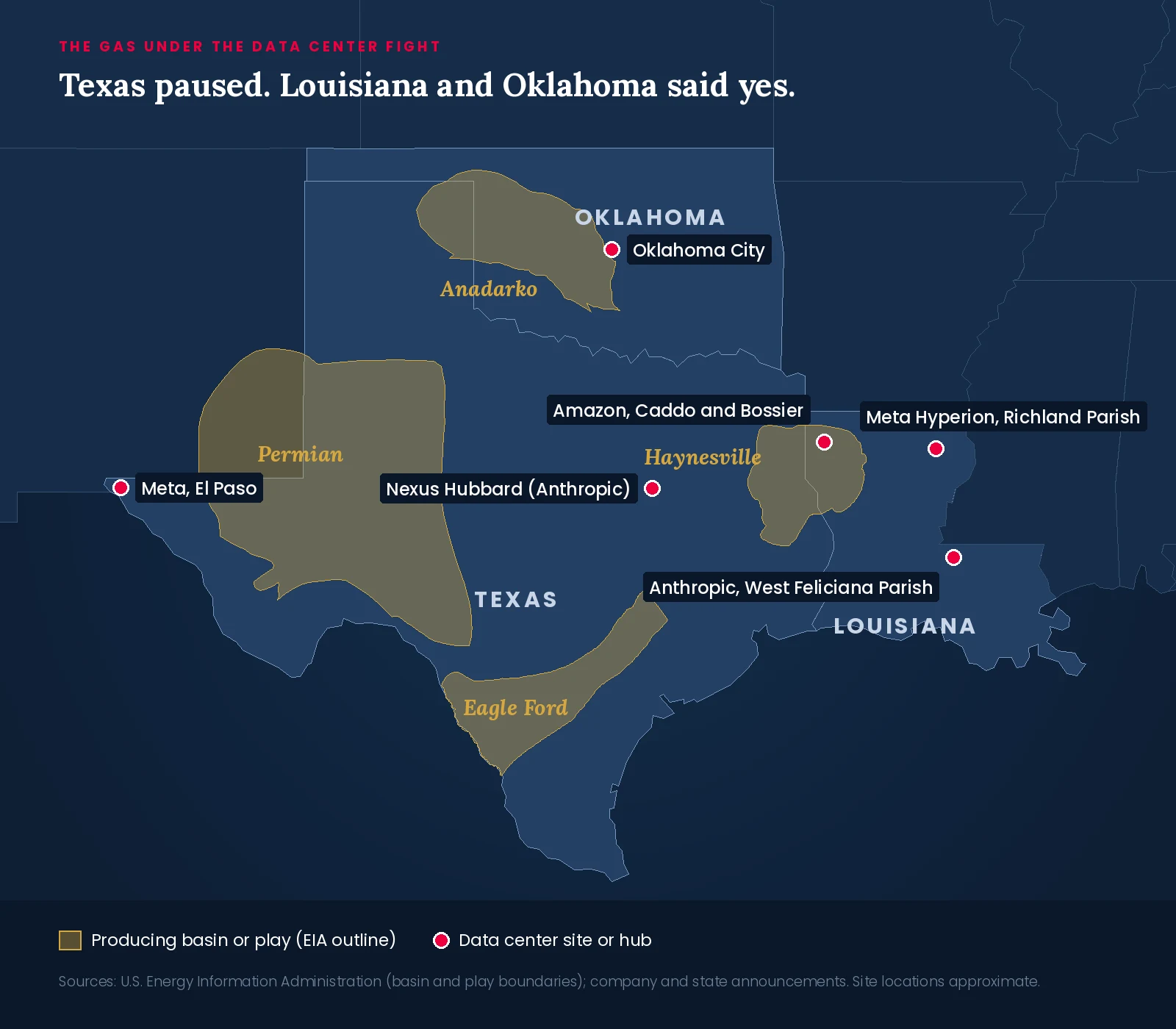
Louisiana is already home to the largest data center being built in the country.13 Meta's Hyperion campus in Richland Parish is planned at 5 gigawatts. Entergy won approval in 2025 for three gas-fired plants to serve it and plans seven more, totaling 5.2 gigawatts and $12.9 billion, pending state approval. Entergy signed a 20-year gas supply agreement for the new plants, and a dedicated pipeline to feed them is seeking federal approval.17, 18
Amazon is building three data centers in Caddo and Bossier parishes around Shreveport, which P&GJ describes as "in the heart of the Haynesville formation."4 Anthropic plans a $10 billion center in West Feliciana Parish.
Gov. Jeff Landry signed an executive order in June to keep household utility customers from covering data center power costs, and in the same breath made the case for more of these projects. On Election Day, Republicans won both open seats on the Public Service Commission, the panel that approves those utility deals, and widened their majority. Louisiana has its skeptics too. New Orleans passed a one-year ban this year. But the state's message to a developer leaving Texas is clear: come, pay your own way, and we'll get you power.
Oklahoma did its work in the spring. House Bill 2992, signed in May and in effect since July 1, requires data centers and similar facilities adding 75 megawatts or more to pay for the infrastructure that serves them. Thirty-six lawmakers from both parties signed on as co-authors.19 A developer knows the price of admission before buying land.
Mike Mazzei won the governor's race on Nov. 3. During the campaign he said data centers approved by local communities should be the guardrails20 and argued some incentive packages give away far more than they bring back in taxes.21 Expect him to push on incentives and leave the door open.
The cities are more cautious. Oklahoma City paused new data centers through the end of 2026, and the mayor has asked to extend it six months, even as the council rezoned two sites for data centers. Edmond extended its pause through June 30, 2027, Norman adopted one through June 2027, and Shawnee through the end of 2027. The difference from Texas is that the state set its rules and left the local fights local. The pauses go city by city, and the state itself is open.
| Texas | Louisiana | Oklahoma | |
|---|---|---|---|
| Statewide posture | Approvals and permits paused; governor-elect promises a moratorium until new laws pass | Courting projects; June order protects ratepayers | Open; 2026 law sets the terms |
| Who pays for the grid | To be written in the 2027 session | Data centers, per the governor's order and utility deals | Data centers adding 75 MW or more, by law |
| Local pauses | Some cities and counties; Fort Worth weighing one | New Orleans | Oklahoma City, Edmond, Norman, Shawnee |
| Gas underneath | Permian, Eagle Ford, Haynesville | Haynesville | Anadarko |
| Rigs this week | 277 | 37 | 49 |
Table 1. Three neighbors, three sets of rules. Rigs are oil and gas combined, Baker Hughes, week ending Nov. 13.22
Capital goes where it's valued most, and right now Louisiana and Oklahoma are valuing it. Both states said yes and wrote down what yes costs. Texas said wait, and won't say for how long until the Legislature acts.
For gas producers, the location matters less than whether the plant gets built and whether a pipeline connects it. The Haynesville straddles Texas and Louisiana, so East Texas gas can still feed a Louisiana plant. The Permian is the one to watch. Those West Texas campuses were the closest thing Permian gas had to a local customer, and if they don't get built, that gas waits on pipelines again.
We're well placed for this. Basin Ventures holds interests in natural gas wells in Oklahoma's Anadarko Basin and Louisiana's Haynesville, and we just closed on more Oklahoma gas wells. That gas sits under the two states most eager for these projects.
I won't pretend the border is a wall. The backlash against data centers is national, and developers can't count on escaping it by moving to Louisiana or Oklahoma. What they can count on is a set of rules they can read. That's what I'd want before committing capital, and it's what every state should be able to offer.
On your power bill, the trend in all three states is toward making data centers pay for the plants and wires they need, and that protects you. In Texas the details get written this winter and spring. Watch for the ERCOT audit in December and the bills that move after Jan. 12.
If you own energy or you're thinking about it, the demand that data centers promised natural gas is still there. Where it lands decides which gas gets a premium and which gas waits on a pipeline.
That's what Basin Ventures does. We invest alongside established, mostly publicly traded operators in American oil and natural gas wells, and we underwrite on conservative long-term price assumptions.
Basin Ventures Fund V is open to accredited investors now. It holds interests in wells in Oklahoma's Anadarko Basin, an oil, gas and NGL play, and in Louisiana's Haynesville, which is all natural gas. To learn more, visit basinventures.com.
I write about supply, demand and energy policy every week. Follow along at @TheTXOilMan on X, Instagram, Facebook and LinkedIn.
This article is for informational purposes only and is not an offer to sell or a solicitation of an offer to buy any security. Investments in oil and gas involve substantial risk, including the possible loss of principal, and are suitable only for accredited investors. Past performance does not guarantee future results.



The short version
Last week I spent an hour with the Houston Chronicle talking about data centers, and I kept coming back to one idea. Capital goes where it's valued most. A company deciding where to put a $10 billion campus will go where it understands the rules and believes they'll still be the rules when the building is finished. Right now that describes Louisiana and Oklahoma better than it describes Texas.
Both parties made data centers a villain this year, so I'd leave red and blue out of it. A Republican governor stopped the approvals in Texas. A Democrat beat him promising to stop them longer. What a developer sees from the outside is a state where nobody can tell them when the door reopens or what it'll cost to walk through it.
Our gas needs somewhere to go. In Texas and everywhere else, a lot of the gas wells drilled over the past two years were drilled expecting a big new need for the gas, and power for data centers was a large part of that expectation. LNG exports, natural gas chilled to a liquid and shipped overseas, were the other part. Now one of those two buyers isn't sure.
We've seen what happens when gas has nowhere to go. At the Waha hub in West Texas, where Permian gas is priced, gas traded below zero on 134 of 245 trading days between October 2025 and September 2026.1 Most Permian gas comes up alongside oil, so when the pipelines out of the basin filled up, producers would rather pay someone to take the gas than shut in their oil wells. The pipes didn't get any bigger. The negative price decided whose gas got a spot on them, and paid local power plants and storage to take the rest.
More supply is on the way. Enverus expects Haynesville output to reach 18.4 billion cubic feet a day by the end of 2027, and expects new Haynesville supply plus new Permian pipelines to outrun new LNG demand by about 1.3 billion cubic feet a day, leaving the domestic market to soak up the difference.2 Power plants serving data centers were supposed to be a big part of that domestic market.
A gas-fired power plant feeding a 1-gigawatt campus around the clock burns about 160 million cubic feet of gas a day (Figure 1). GLJ Research estimates about 13 gigawatts of Texas data center capacity is immediately exposed by the election.3 If all of it ran on gas at full load, that would be about 2.1 billion cubic feet a day, or roughly 13% of what the Haynesville is expected to produce this year.4 That's a ceiling. Not every campus runs on gas, and not every one runs at full load around the clock. LNG is still the bigger buyer today; one estimate puts new data center gas demand this year near 0.5 billion cubic feet a day, against 3.7 for new LNG.5 Data centers were the growth that came next, and gas producers built for it.
On Aug. 3, Gov. Greg Abbott told the state's grid operator, ERCOT, and the Public Utility Commission to stop approving new data center connections until an audit was done. As many as 474 gigawatts of projects were asking to plug into ERCOT, more than five times the grid's all-time demand record.6 On Sept. 21 he went further and told the state environmental agency, TCEQ, to issue no permits for data center projects until they finished the audits.7
Then Gina Hinojosa beat him. During the campaign she promised a moratorium, which she described as a ban, on all data center approvals until the Legislature passes laws to protect Texans. The ERCOT audit is expected in December, the Legislature meets in January, and she takes office Jan. 19. Her message to the industry after the election: "I hate the way they are taking advantage of Texas."8
The tax break is on the table too. Texas exempts qualifying data centers from state sales tax on their equipment and electricity, and the Senate Finance Committee projects that will cost the state about $3.3 billion in the 2028-29 budget.9
Lawmakers didn't wait for January. At least five bills to repeal that exemption were filed on the first day lawmakers could file bills for the 2027 session, and the Senate version from Finance Committee Chair Joan Huffman, a Houston Republican, picked up 23 of the Senate's 31 members and members-elect as authors.10 Three days later SpaceX announced a $24 billion data center at Starbase, and the governor-elect said her moratorium would apply to it like any other.11 Closer to home for us, Fort Worth held its first public hearing Nov. 10 on a 90-day moratorium of its own that it could adopt in February.
Asking data centers to pay for the power plants, wires and water they need is fair. Oklahoma and Louisiana have both written that into their rules, and neither one told the industry to stop while they did it. The trouble in Texas is the open end. A developer ordering turbines and transformers for delivery years from now can price a tariff or a fee. A moratorium with no end date is much harder to price, so the money either waits or goes somewhere it can be put to work.
The projects already underway are safest. Reports indicate projects that already hold permits would be allowed to finish construction.12 That includes some giants: Nexus Hubbard, planned at 6,400 megawatts and meant mostly to serve Anthropic, is under construction in Central Texas.13 GLJ's Gordon Johnson sorted the rest into tiers. Projects with power, permits and steel keep going. Projects with power but no state environmental permits slip 12 to 18 months. And he wrote that projects with neither "probably go to Louisiana, Oklahoma or nowhere."3
Developers told the Chronicle the same thing in their own words. Some said they're committed to staying in Texas, and others said they'd look at more welcoming states.14 Texas holds about a quarter of the planned data center capacity in the U.S., according to Goldman Sachs,15 and Cleanview counts about 40% of pending U.S. capacity in states where newly elected governors promised to stop or pause construction.16 When that much of the pipeline is in question at once, the states that say yes get a long look.
My read on what's likely in Texas:
Louisiana is already home to the largest data center being built in the country.13 Meta's Hyperion campus in Richland Parish is planned at 5 gigawatts. Entergy won approval in 2025 for three gas-fired plants to serve it and plans seven more, totaling 5.2 gigawatts and $12.9 billion, pending state approval. Entergy signed a 20-year gas supply agreement for the new plants, and a dedicated pipeline to feed them is seeking federal approval.17, 18
Amazon is building three data centers in Caddo and Bossier parishes around Shreveport, which P&GJ describes as "in the heart of the Haynesville formation."4 Anthropic plans a $10 billion center in West Feliciana Parish.
Gov. Jeff Landry signed an executive order in June to keep household utility customers from covering data center power costs, and in the same breath made the case for more of these projects. On Election Day, Republicans won both open seats on the Public Service Commission, the panel that approves those utility deals, and widened their majority. Louisiana has its skeptics too. New Orleans passed a one-year ban this year. But the state's message to a developer leaving Texas is clear: come, pay your own way, and we'll get you power.
Oklahoma did its work in the spring. House Bill 2992, signed in May and in effect since July 1, requires data centers and similar facilities adding 75 megawatts or more to pay for the infrastructure that serves them. Thirty-six lawmakers from both parties signed on as co-authors.19 A developer knows the price of admission before buying land.
Mike Mazzei won the governor's race on Nov. 3. During the campaign he said data centers approved by local communities should be the guardrails20 and argued some incentive packages give away far more than they bring back in taxes.21 Expect him to push on incentives and leave the door open.
The cities are more cautious. Oklahoma City paused new data centers through the end of 2026, and the mayor has asked to extend it six months, even as the council rezoned two sites for data centers. Edmond extended its pause through June 30, 2027, Norman adopted one through June 2027, and Shawnee through the end of 2027. The difference from Texas is that the state set its rules and left the local fights local. The pauses go city by city, and the state itself is open.
| Texas | Louisiana | Oklahoma | |
|---|---|---|---|
| Statewide posture | Approvals and permits paused; governor-elect promises a moratorium until new laws pass | Courting projects; June order protects ratepayers | Open; 2026 law sets the terms |
| Who pays for the grid | To be written in the 2027 session | Data centers, per the governor's order and utility deals | Data centers adding 75 MW or more, by law |
| Local pauses | Some cities and counties; Fort Worth weighing one | New Orleans | Oklahoma City, Edmond, Norman, Shawnee |
| Gas underneath | Permian, Eagle Ford, Haynesville | Haynesville | Anadarko |
| Rigs this week | 277 | 37 | 49 |
Table 1. Three neighbors, three sets of rules. Rigs are oil and gas combined, Baker Hughes, week ending Nov. 13.22
Capital goes where it's valued most, and right now Louisiana and Oklahoma are valuing it. Both states said yes and wrote down what yes costs. Texas said wait, and won't say for how long until the Legislature acts.
For gas producers, the location matters less than whether the plant gets built and whether a pipeline connects it. The Haynesville straddles Texas and Louisiana, so East Texas gas can still feed a Louisiana plant. The Permian is the one to watch. Those West Texas campuses were the closest thing Permian gas had to a local customer, and if they don't get built, that gas waits on pipelines again.
We're well placed for this. Basin Ventures holds interests in natural gas wells in Oklahoma's Anadarko Basin and Louisiana's Haynesville, and we just closed on more Oklahoma gas wells. That gas sits under the two states most eager for these projects.
I won't pretend the border is a wall. The backlash against data centers is national, and developers can't count on escaping it by moving to Louisiana or Oklahoma. What they can count on is a set of rules they can read. That's what I'd want before committing capital, and it's what every state should be able to offer.
On your power bill, the trend in all three states is toward making data centers pay for the plants and wires they need, and that protects you. In Texas the details get written this winter and spring. Watch for the ERCOT audit in December and the bills that move after Jan. 12.
If you own energy or you're thinking about it, the demand that data centers promised natural gas is still there. Where it lands decides which gas gets a premium and which gas waits on a pipeline.
That's what Basin Ventures does. We invest alongside established, mostly publicly traded operators in American oil and natural gas wells, and we underwrite on conservative long-term price assumptions.
Basin Ventures Fund V is open to accredited investors now. It holds interests in wells in Oklahoma's Anadarko Basin, an oil, gas and NGL play, and in Louisiana's Haynesville, which is all natural gas. To learn more, visit basinventures.com.
I write about supply, demand and energy policy every week. Follow along at @TheTXOilMan on X, Instagram, Facebook and LinkedIn.
This article is for informational purposes only and is not an offer to sell or a solicitation of an offer to buy any security. Investments in oil and gas involve substantial risk, including the possible loss of principal, and are suitable only for accredited investors. Past performance does not guarantee future results.

© Copyright 2026 Basin Ventures II, LLC. All rights reserved.