Watch Replay: Basin Ventures Q3 Investor Webinar
Watch Now



The short version
Texas elected its first Democratic governor since Ann Richards in 1990.1 The Associated Press called the race for Gina Hinojosa over Greg Abbott,2 NBC and CBS projected James Talarico over Ken Paxton for the U.S. Senate,3 and Jon Rosenthal is the first Democrat elected to the Railroad Commission, the state's oil and gas regulator, since 1990.4 In unofficial counts early Wednesday, Talarico led about 54.9% to 43.1%5 and Hinojosa about 52.7% to 45.8%.6 In Tarrant County, Democrats won every contested countywide race and a 4-1 majority on the commissioners court.7, 8
Nationally, the AP called both the House and the Senate for Democrats.9 The Senate races in Alaska and Mississippi were still too close to call.10
If you own energy, or just pay for it, you want to know what changes. Less than the headlines suggest in Washington. Some in Austin. The most on the power grid.
In the exit poll run for the networks and the AP, cost of living was a crucial or major factor for 89% of voters and the war in Iran for 74%. And 54% said they were very concerned about utility costs.11 The Texas Tribune's read was that "the crushing cost of groceries and gas hit the Republican brand especially hard."12 On the eve of the election, gasoline was up 38% from a year earlier13 and diesel was up 68%.14
Texans in one September poll pointed to the war. UMass Lowell found 72% of likely voters named the Iran war as the main cause of higher energy costs, and 4% named AI data centers.15
The swing among young voters tells you how fast patience ran out. In 2024, 56% of young men backed President Trump. On Tuesday, 63% of them voted for Democrats for the House. Young white voters went from 54% for Trump to 62% for Democrats, though those comparisons set a presidential race against House races.16 The typical first-time homebuyer in America is now 40 years old.17 If you're 22, the price of diesel lands on top of a house you already can't see how to buy.
By Wednesday afternoon, December crude had fallen about $8 to about $88.50 a barrel, and more than $15 since Friday's close. Brent, the global benchmark, was about $95.18 Vice President JD Vance gave traders their headline: "The reason we lost is the war." President Trump told the Financial Times he had no immediate plans to strike Iran, and told Fox News of the defeat, "I think it's the gasoline price."19 "The elections are leading the market to conclude that Trump might now be inclined to make a deal," said Andy Lipow of Lipow Oil Associates.20 Democratic senators have also talked openly about using spending power to pressure an end to the war, and Sen. Richard Blumenthal called it "the most likely means."21
No deal exists yet. A senior Iranian official said this week the two sides remain far from one,22 and a tanker was hit off Oman on Tuesday.23 Carl Larry of Enverus said, "I'm more concerned that we can see an escalation in Iran sooner than a resolution."24
The headline price misses two things. The first is what's in the tanks. EIA reported Wednesday that U.S. stocks of diesel and heating oil fell to 99.3 million barrels, the first time under 100 million since 2003. They stood at 120.8 million in late February, as the war began.25, 26 Diesel futures still trade about $89 a barrel above crude,18 and diesel at the pump is $6.27, up $2.58 from a year ago.27 Cheaper crude helps, but it doesn't refill a diesel tank. Refining is the bottleneck.
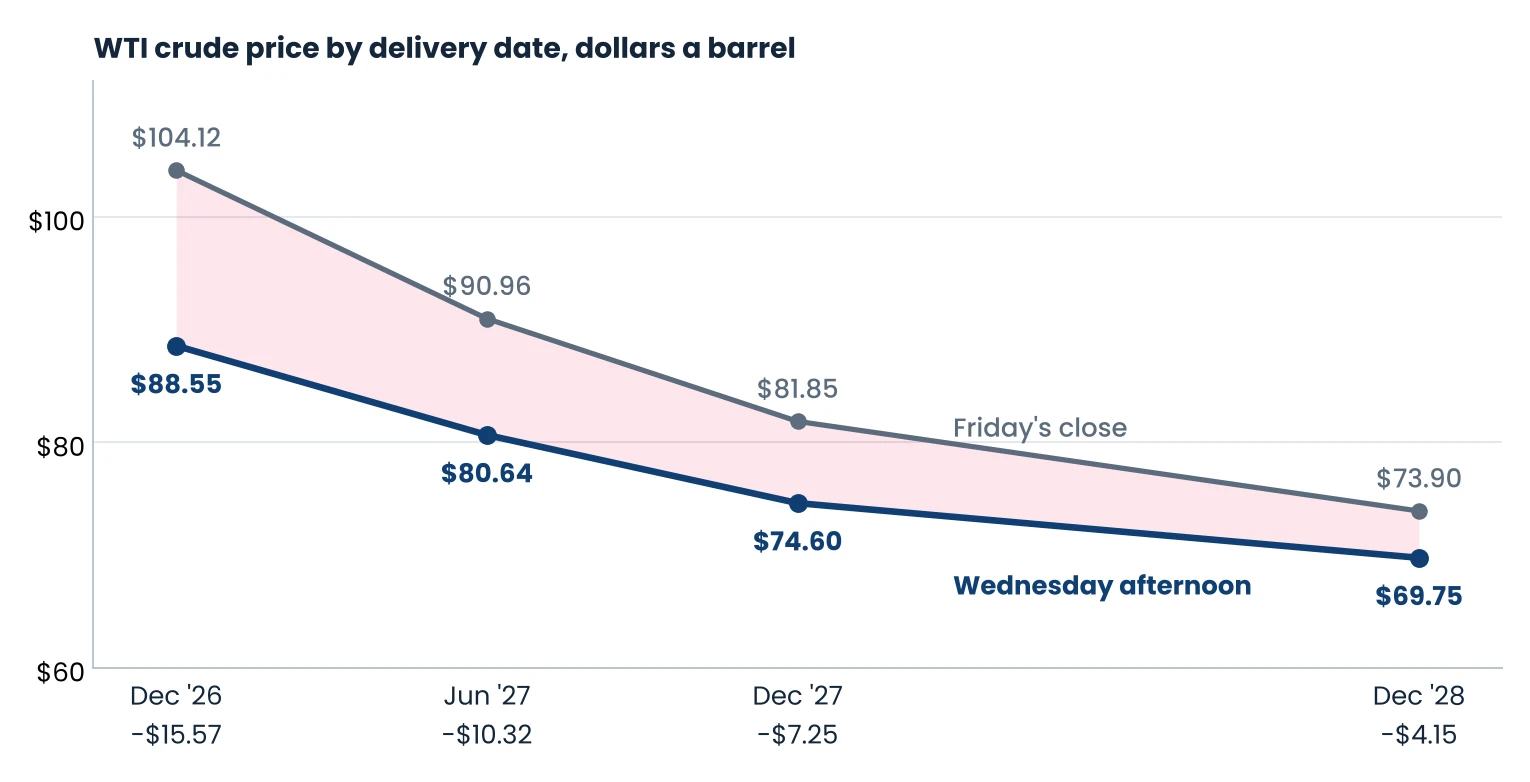
The second is further down the futures curve, the prices for oil delivered in later months and years. Oil for delivery in December 2028 fell under $70 (Figure 1).18 Those later prices are what drilling budgets get built on, because a well produces for years. So the headline that helps you at the pump can also slow the next round of American drilling, in the same week U.S. crude output hit a weekly record of 14 million barrels a day.25
President Trump holds the veto until January 2029, and Democrats, at about 54 Senate seats, won't have the two-thirds needed to override it.10 That means the 2025 budget law, which cut the onshore federal royalty back to 12.5% and ordered 30 Gulf lease sales, stays on the books.28 The Congressional Review Act, the fast track Congress uses to kill regulations, also needs the President's signature or an override.29
History says divided government blocks the big swings and still passes energy law, usually attached to a bill that has to pass. The closest match to this year is 2006, when Democrats took both chambers under a Republican President.
| Election | Who held what | What got blocked | What passed |
|---|---|---|---|
| 2006 | D Congress, R President | Renewable power mandate and oil subsidy repeal, stripped in the Senate30 | 2007 energy law: 35 mpg standard and a bigger ethanol mandate30 |
| 2014 | R Congress, D President | Keystone XL, vetoed31 | 40-year crude export ban lifted in a 2015 spending bill, paired with wind and solar credits32 |
| 2018 | D House, R Senate, R President | House offshore drilling bans, not expected to move in the Senate33 | Energy Act of 2020, inside a spending bill34 |
| 2022 | R House, D Senate, D President | House energy package, "dead on arrival"35 | Permitting deadlines and the Mountain Valley pipeline, in the 2023 debt-limit law36 |
Table 1. Four divided-government elections since 2006: the big bills stall and the deals ride on must-pass legislation.
What the new majority can do is ask questions under oath. S&P Global expected a Democratic House to investigate Interior's offshore wind buyout and to use subpoena power on gas and LNG.37 Before the vote, Standard Chartered's Emily Ashford said a sweep "would not automatically reverse" oil and gas policy but expected more uncertainty and a harder road for energy bills, with sharper effects on natural gas and LNG infrastructure.38 LNG is natural gas chilled to a liquid so it can ship overseas. In February, Sen. Elizabeth Warren and nine colleagues asked Energy Secretary Chris Wright to reverse course on doubling LNG exports,39 and Sen. Jeff Merkley has a bill that would treat new export terminals as against the public interest if they raise consumer prices.40 The Energy Department still makes those approvals under this President.
The first test comes Monday, Nov. 9, and none of Tuesday's winners get a vote. The outgoing Senate takes up a bipartisan permitting bill that would shorten reviews and lawsuits and make data center developers pay their own electricity costs. It needs 60 votes to advance,41 so with 53 Republican seats, at least 7 Democrats have to say yes less than a week after their party won. Rep. Jared Huffman, the top Democrat on House Natural Resources, says "Folding our hand now or in the lame duck makes no sense." Rep. Scott Peters, also a Democrat, says it "ought to be voted on this Congress."42 Even if it clears the Senate, it still has to be squared with a bill the House passed last year.43 It would also limit the government's ability to rescind permits already in effect.44 For anyone financing a pipeline or a power plant, that limit matters most.
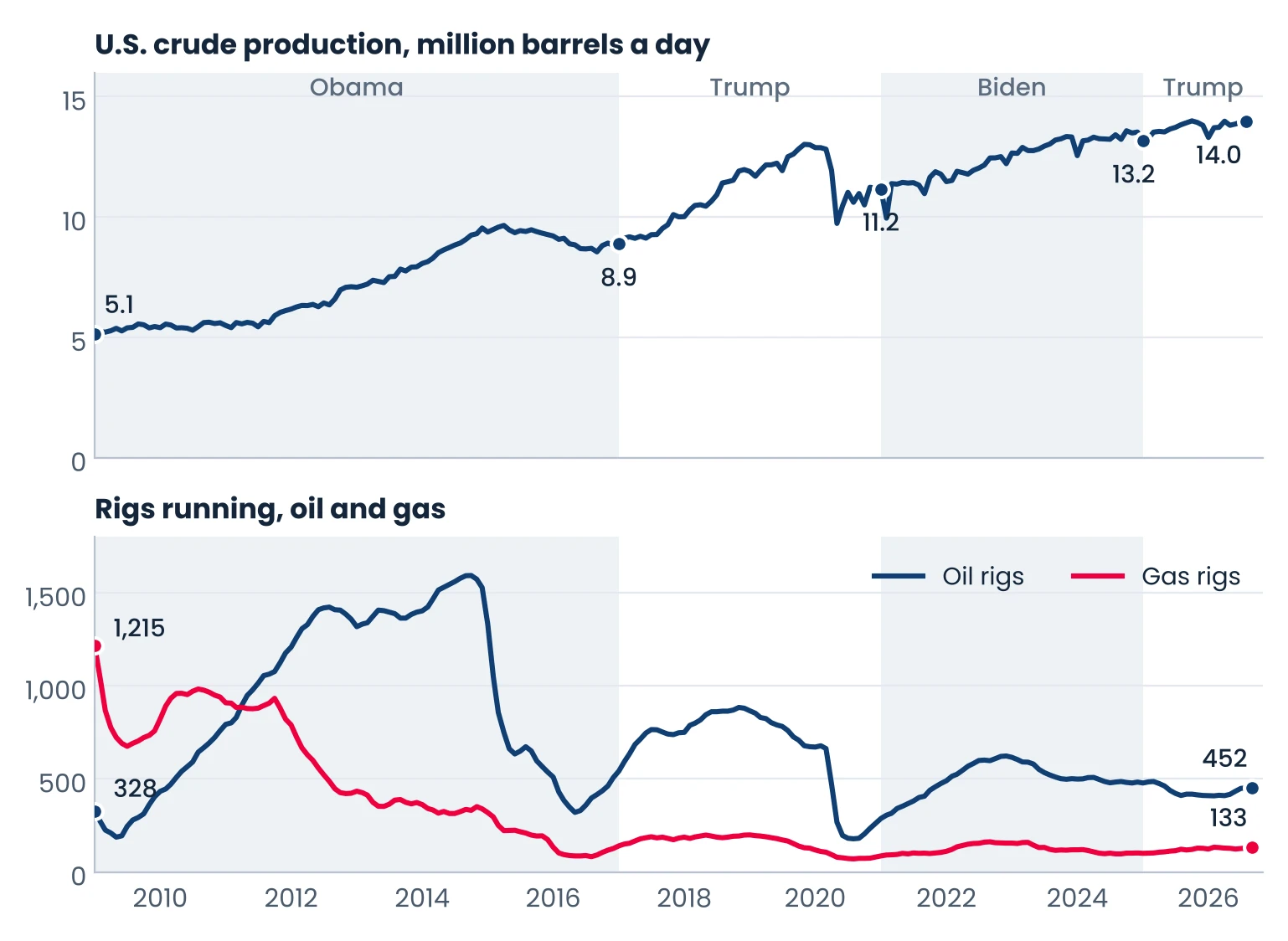
Washington also gets too much credit and too much blame for the barrels. U.S. crude went from 5.1 million barrels a day in January 2009 to nearly 14 million in August45 while oil rigs went from 328 to 452,46 so each rig is doing about twice the work. Federal land and waters together produced about a quarter of U.S. oil in 2024, about 13% onshore and 14% offshore. The rest came from state and private land.47
The price answers to the world, and this week it answered to the war.
Hinojosa takes office in January48 with executive action, appointments, special sessions and the veto.12 She campaigned on declaring a "high-cost emergency," suspending gas and diesel taxes and freezing electricity rates by order.49 We haven't seen anyone confirm a governor can freeze rates that way. Democrat Vikki Goodwin beat Dan Patrick for lieutenant governor, the office that presides over the Texas Senate. Republicans keep their majority there, 20-11, and are already talking about curbing her authority.12, 50 The Texas House is the bigger surprise. Unofficial early results show Democrats flipping at least 18 seats for about a 90-60 majority, ending Republican control that dates to 2003.50 So a Democratic governor and House will have to deal with a Republican Senate, and most ambitious bills on either side will have to get through both.
Other statewide offices touch this business too. Benjamin Flores takes over the General Land Office, which leases state land for oil and gas and sends that money to Texas schools, and he's promised more transparency in how state land is managed. Sarah Eckhardt becomes comptroller, the office that collects severance taxes, and Clayton Tucker, the new agriculture commissioner, has sought a moratorium on new AI data centers.51
Washington gets the headlines, but the risk I'm watching is closer to home. Most American oil comes from state and private land,47 so the rules that matter most get written in state capitals. That's how California and New York did it. California banned new wells within 3,200 feet of homes and schools.52 New York banned fracking outright.53 I'm not saying Texas gets there. We're a lot closer today than we were yesterday.
Flaring is where I'd expect the fight to start. Flaring means burning natural gas at the well when there's nowhere to send it. Jon Rosenthal, the new Railroad Commissioner, ran on ending flaring and venting except in emergencies,54 along with a first-of-its-kind fee on injecting oil field wastewater underground and a crackdown on natural gas facilities' emergency preparedness.55 An oil well produces gas whether you want it or not, and when the pipelines are full in the Permian or the Eagle Ford, the choice is to flare it or shut in the well. Permian gas sold below zero for a record 25 straight days earlier this year because the pipelines couldn't carry it all.56 A hard limit on flaring without the pipelines to go with it is a limit on oil production.
The Texas Democratic Party's own platform points the same direction: "newer, stricter rules on injection wells," strict methane enforcement at every well and tank, enforcing a state law against drilling in "thickly settled communities" unless cities adopt their own rules, and an end to "leasing of public lands for fracking."57 Rosenthal calls himself a "drill baby, drill Democrat."4 I have a hard time picturing what a pro-fossil fuel Democrat looks like when that's the party's agenda, and I expect most of them to fall in line with it when it counts. He can prove me wrong.
There are checks. Rosenthal "likely will be outvoted 2-1 on many issues,"55 and a Republican Texas Senate can stop a bill. But one commission seat comes up every 2 years, and when a seat comes open, the governor appoints the replacement until the next general election.58 One more seat is a majority.
Other oil states split. New Mexico, about 17% of U.S. crude this year,59 elected Deb Haaland.60 As Interior Secretary she paused federal leasing and still processed more drilling permits than the first Trump administration.61 Oklahoma stayed Republican with Mike Mazzei.62
The fastest change may be on the power grid. Exit polls found 76% of voters opposed a new data center in their community, and 56% called AI and data centers a crucial or major factor in their vote.11 Voters in at least 14 Ohio municipalities passed bans or restrictions.63, 64 Hinojosa wants a moratorium on new data centers until the Legislature sets rules,65 and Texas holds about 27% of planned U.S. capacity.66 Republicans were on both sides of this one too: Abbott halted new permits before the election and lost anyway.67 That takes some of the shine off natural gas demand without erasing it, since gas still has homes, factories, existing power plants and LNG. This one deserves its own discussion, and I'll have more on it next week at @TheTXOilMan.
At the pump, Congress has limited direct influence beyond a possible gas tax holiday. Before the vote, an Atlantic Council analysis said it also has little sway over the Iran conflict.68 Oil traders just bet otherwise, and if they're right, gasoline should feel it first, with diesel lagging until the tanks refill. On your power bill, expect a long fight over who pays for the grid.
If you own energy or you're thinking about it, this is a reminder that political risk runs both ways. The people who finance wells, pipelines and refineries need to know the rules will hold still. The question for these new officeholders is the one we'd ask of any: can an American get a permit and count on it after the next election? We'll see what the lame duck does with the permitting bill, then what the new Congress does in January.
That's what Basin Ventures does. We invest alongside established, mostly publicly traded operators in American oil and natural gas wells, and we underwrite on conservative long-term price assumptions.
Basin Ventures Fund V is open to accredited investors now. It holds interests in wells in Oklahoma's Anadarko Basin, an oil, gas and NGL play, and in Louisiana's Haynesville, which is all natural gas. To learn more, visit basinventures.com.
I write about supply, demand and energy policy every week. Follow along at @TheTXOilMan on X, Instagram, Facebook and LinkedIn.
This article is for informational purposes only and is not an offer to sell or a solicitation of an offer to buy any security. Investments in oil and gas involve substantial risk, including the possible loss of principal, and are suitable only for accredited investors. Past performance does not guarantee future results.



The short version
Texas elected its first Democratic governor since Ann Richards in 1990.1 The Associated Press called the race for Gina Hinojosa over Greg Abbott,2 NBC and CBS projected James Talarico over Ken Paxton for the U.S. Senate,3 and Jon Rosenthal is the first Democrat elected to the Railroad Commission, the state's oil and gas regulator, since 1990.4 In unofficial counts early Wednesday, Talarico led about 54.9% to 43.1%5 and Hinojosa about 52.7% to 45.8%.6 In Tarrant County, Democrats won every contested countywide race and a 4-1 majority on the commissioners court.7, 8
Nationally, the AP called both the House and the Senate for Democrats.9 The Senate races in Alaska and Mississippi were still too close to call.10
If you own energy, or just pay for it, you want to know what changes. Less than the headlines suggest in Washington. Some in Austin. The most on the power grid.
In the exit poll run for the networks and the AP, cost of living was a crucial or major factor for 89% of voters and the war in Iran for 74%. And 54% said they were very concerned about utility costs.11 The Texas Tribune's read was that "the crushing cost of groceries and gas hit the Republican brand especially hard."12 On the eve of the election, gasoline was up 38% from a year earlier13 and diesel was up 68%.14
Texans in one September poll pointed to the war. UMass Lowell found 72% of likely voters named the Iran war as the main cause of higher energy costs, and 4% named AI data centers.15
The swing among young voters tells you how fast patience ran out. In 2024, 56% of young men backed President Trump. On Tuesday, 63% of them voted for Democrats for the House. Young white voters went from 54% for Trump to 62% for Democrats, though those comparisons set a presidential race against House races.16 The typical first-time homebuyer in America is now 40 years old.17 If you're 22, the price of diesel lands on top of a house you already can't see how to buy.
By Wednesday afternoon, December crude had fallen about $8 to about $88.50 a barrel, and more than $15 since Friday's close. Brent, the global benchmark, was about $95.18 Vice President JD Vance gave traders their headline: "The reason we lost is the war." President Trump told the Financial Times he had no immediate plans to strike Iran, and told Fox News of the defeat, "I think it's the gasoline price."19 "The elections are leading the market to conclude that Trump might now be inclined to make a deal," said Andy Lipow of Lipow Oil Associates.20 Democratic senators have also talked openly about using spending power to pressure an end to the war, and Sen. Richard Blumenthal called it "the most likely means."21
No deal exists yet. A senior Iranian official said this week the two sides remain far from one,22 and a tanker was hit off Oman on Tuesday.23 Carl Larry of Enverus said, "I'm more concerned that we can see an escalation in Iran sooner than a resolution."24
The headline price misses two things. The first is what's in the tanks. EIA reported Wednesday that U.S. stocks of diesel and heating oil fell to 99.3 million barrels, the first time under 100 million since 2003. They stood at 120.8 million in late February, as the war began.25, 26 Diesel futures still trade about $89 a barrel above crude,18 and diesel at the pump is $6.27, up $2.58 from a year ago.27 Cheaper crude helps, but it doesn't refill a diesel tank. Refining is the bottleneck.
The second is further down the futures curve, the prices for oil delivered in later months and years. Oil for delivery in December 2028 fell under $70 (Figure 1).18 Those later prices are what drilling budgets get built on, because a well produces for years. So the headline that helps you at the pump can also slow the next round of American drilling, in the same week U.S. crude output hit a weekly record of 14 million barrels a day.25
President Trump holds the veto until January 2029, and Democrats, at about 54 Senate seats, won't have the two-thirds needed to override it.10 That means the 2025 budget law, which cut the onshore federal royalty back to 12.5% and ordered 30 Gulf lease sales, stays on the books.28 The Congressional Review Act, the fast track Congress uses to kill regulations, also needs the President's signature or an override.29
History says divided government blocks the big swings and still passes energy law, usually attached to a bill that has to pass. The closest match to this year is 2006, when Democrats took both chambers under a Republican President.
| Election | Who held what | What got blocked | What passed |
|---|---|---|---|
| 2006 | D Congress, R President | Renewable power mandate and oil subsidy repeal, stripped in the Senate30 | 2007 energy law: 35 mpg standard and a bigger ethanol mandate30 |
| 2014 | R Congress, D President | Keystone XL, vetoed31 | 40-year crude export ban lifted in a 2015 spending bill, paired with wind and solar credits32 |
| 2018 | D House, R Senate, R President | House offshore drilling bans, not expected to move in the Senate33 | Energy Act of 2020, inside a spending bill34 |
| 2022 | R House, D Senate, D President | House energy package, "dead on arrival"35 | Permitting deadlines and the Mountain Valley pipeline, in the 2023 debt-limit law36 |
Table 1. Four divided-government elections since 2006: the big bills stall and the deals ride on must-pass legislation.
What the new majority can do is ask questions under oath. S&P Global expected a Democratic House to investigate Interior's offshore wind buyout and to use subpoena power on gas and LNG.37 Before the vote, Standard Chartered's Emily Ashford said a sweep "would not automatically reverse" oil and gas policy but expected more uncertainty and a harder road for energy bills, with sharper effects on natural gas and LNG infrastructure.38 LNG is natural gas chilled to a liquid so it can ship overseas. In February, Sen. Elizabeth Warren and nine colleagues asked Energy Secretary Chris Wright to reverse course on doubling LNG exports,39 and Sen. Jeff Merkley has a bill that would treat new export terminals as against the public interest if they raise consumer prices.40 The Energy Department still makes those approvals under this President.
The first test comes Monday, Nov. 9, and none of Tuesday's winners get a vote. The outgoing Senate takes up a bipartisan permitting bill that would shorten reviews and lawsuits and make data center developers pay their own electricity costs. It needs 60 votes to advance,41 so with 53 Republican seats, at least 7 Democrats have to say yes less than a week after their party won. Rep. Jared Huffman, the top Democrat on House Natural Resources, says "Folding our hand now or in the lame duck makes no sense." Rep. Scott Peters, also a Democrat, says it "ought to be voted on this Congress."42 Even if it clears the Senate, it still has to be squared with a bill the House passed last year.43 It would also limit the government's ability to rescind permits already in effect.44 For anyone financing a pipeline or a power plant, that limit matters most.
Washington also gets too much credit and too much blame for the barrels. U.S. crude went from 5.1 million barrels a day in January 2009 to nearly 14 million in August45 while oil rigs went from 328 to 452,46 so each rig is doing about twice the work. Federal land and waters together produced about a quarter of U.S. oil in 2024, about 13% onshore and 14% offshore. The rest came from state and private land.47
The price answers to the world, and this week it answered to the war.
Hinojosa takes office in January48 with executive action, appointments, special sessions and the veto.12 She campaigned on declaring a "high-cost emergency," suspending gas and diesel taxes and freezing electricity rates by order.49 We haven't seen anyone confirm a governor can freeze rates that way. Democrat Vikki Goodwin beat Dan Patrick for lieutenant governor, the office that presides over the Texas Senate. Republicans keep their majority there, 20-11, and are already talking about curbing her authority.12, 50 The Texas House is the bigger surprise. Unofficial early results show Democrats flipping at least 18 seats for about a 90-60 majority, ending Republican control that dates to 2003.50 So a Democratic governor and House will have to deal with a Republican Senate, and most ambitious bills on either side will have to get through both.
Other statewide offices touch this business too. Benjamin Flores takes over the General Land Office, which leases state land for oil and gas and sends that money to Texas schools, and he's promised more transparency in how state land is managed. Sarah Eckhardt becomes comptroller, the office that collects severance taxes, and Clayton Tucker, the new agriculture commissioner, has sought a moratorium on new AI data centers.51
Washington gets the headlines, but the risk I'm watching is closer to home. Most American oil comes from state and private land,47 so the rules that matter most get written in state capitals. That's how California and New York did it. California banned new wells within 3,200 feet of homes and schools.52 New York banned fracking outright.53 I'm not saying Texas gets there. We're a lot closer today than we were yesterday.
Flaring is where I'd expect the fight to start. Flaring means burning natural gas at the well when there's nowhere to send it. Jon Rosenthal, the new Railroad Commissioner, ran on ending flaring and venting except in emergencies,54 along with a first-of-its-kind fee on injecting oil field wastewater underground and a crackdown on natural gas facilities' emergency preparedness.55 An oil well produces gas whether you want it or not, and when the pipelines are full in the Permian or the Eagle Ford, the choice is to flare it or shut in the well. Permian gas sold below zero for a record 25 straight days earlier this year because the pipelines couldn't carry it all.56 A hard limit on flaring without the pipelines to go with it is a limit on oil production.
The Texas Democratic Party's own platform points the same direction: "newer, stricter rules on injection wells," strict methane enforcement at every well and tank, enforcing a state law against drilling in "thickly settled communities" unless cities adopt their own rules, and an end to "leasing of public lands for fracking."57 Rosenthal calls himself a "drill baby, drill Democrat."4 I have a hard time picturing what a pro-fossil fuel Democrat looks like when that's the party's agenda, and I expect most of them to fall in line with it when it counts. He can prove me wrong.
There are checks. Rosenthal "likely will be outvoted 2-1 on many issues,"55 and a Republican Texas Senate can stop a bill. But one commission seat comes up every 2 years, and when a seat comes open, the governor appoints the replacement until the next general election.58 One more seat is a majority.
Other oil states split. New Mexico, about 17% of U.S. crude this year,59 elected Deb Haaland.60 As Interior Secretary she paused federal leasing and still processed more drilling permits than the first Trump administration.61 Oklahoma stayed Republican with Mike Mazzei.62
The fastest change may be on the power grid. Exit polls found 76% of voters opposed a new data center in their community, and 56% called AI and data centers a crucial or major factor in their vote.11 Voters in at least 14 Ohio municipalities passed bans or restrictions.63, 64 Hinojosa wants a moratorium on new data centers until the Legislature sets rules,65 and Texas holds about 27% of planned U.S. capacity.66 Republicans were on both sides of this one too: Abbott halted new permits before the election and lost anyway.67 That takes some of the shine off natural gas demand without erasing it, since gas still has homes, factories, existing power plants and LNG. This one deserves its own discussion, and I'll have more on it next week at @TheTXOilMan.
At the pump, Congress has limited direct influence beyond a possible gas tax holiday. Before the vote, an Atlantic Council analysis said it also has little sway over the Iran conflict.68 Oil traders just bet otherwise, and if they're right, gasoline should feel it first, with diesel lagging until the tanks refill. On your power bill, expect a long fight over who pays for the grid.
If you own energy or you're thinking about it, this is a reminder that political risk runs both ways. The people who finance wells, pipelines and refineries need to know the rules will hold still. The question for these new officeholders is the one we'd ask of any: can an American get a permit and count on it after the next election? We'll see what the lame duck does with the permitting bill, then what the new Congress does in January.
That's what Basin Ventures does. We invest alongside established, mostly publicly traded operators in American oil and natural gas wells, and we underwrite on conservative long-term price assumptions.
Basin Ventures Fund V is open to accredited investors now. It holds interests in wells in Oklahoma's Anadarko Basin, an oil, gas and NGL play, and in Louisiana's Haynesville, which is all natural gas. To learn more, visit basinventures.com.
I write about supply, demand and energy policy every week. Follow along at @TheTXOilMan on X, Instagram, Facebook and LinkedIn.
This article is for informational purposes only and is not an offer to sell or a solicitation of an offer to buy any security. Investments in oil and gas involve substantial risk, including the possible loss of principal, and are suitable only for accredited investors. Past performance does not guarantee future results.

© Copyright 2026 Basin Ventures II, LLC. All rights reserved.