Watch Replay: Basin Ventures Q2 Investor Webinar
Watch Now


Website Cookies
This website uses cookies to ensure you get the best experience on our site.
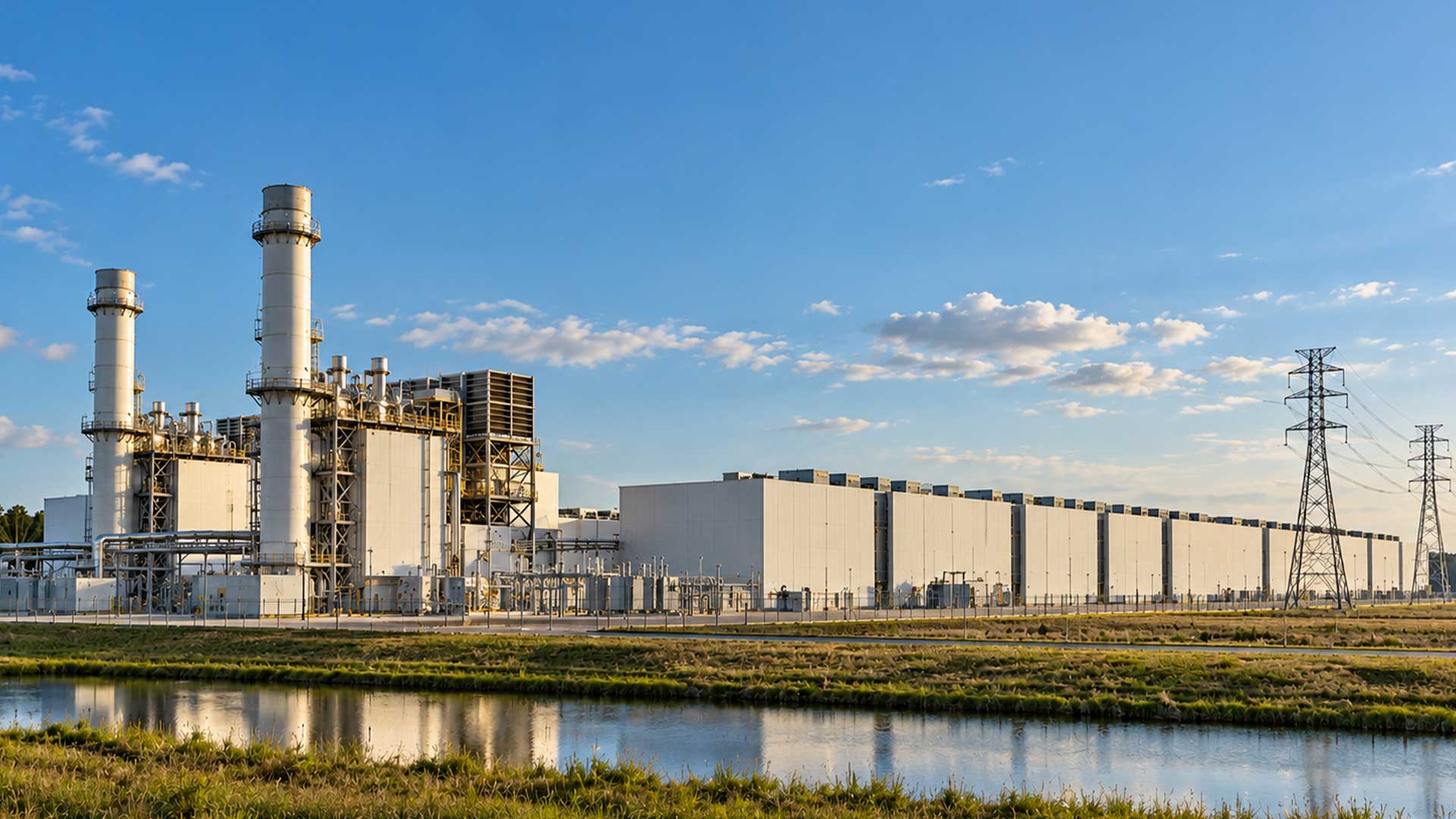


In a rural corner of northeast Louisiana called Richland Parish, Meta is building the largest data center it has ever attempted. It is called Hyperion. And to keep the lights on, the local utility plans to build it 10 natural gas power plants.
Ten. With roughly 7.5 gigawatts of capacity between them, which is more than a 30% increase to the entire state of Louisiana's grid. Fortune put it at enough power for more than 5 million homes, all of it pointed at one campus full of computer servers.
The site sits within about 80 miles of the Haynesville Shale, the third-largest natural gas producing region in the country.
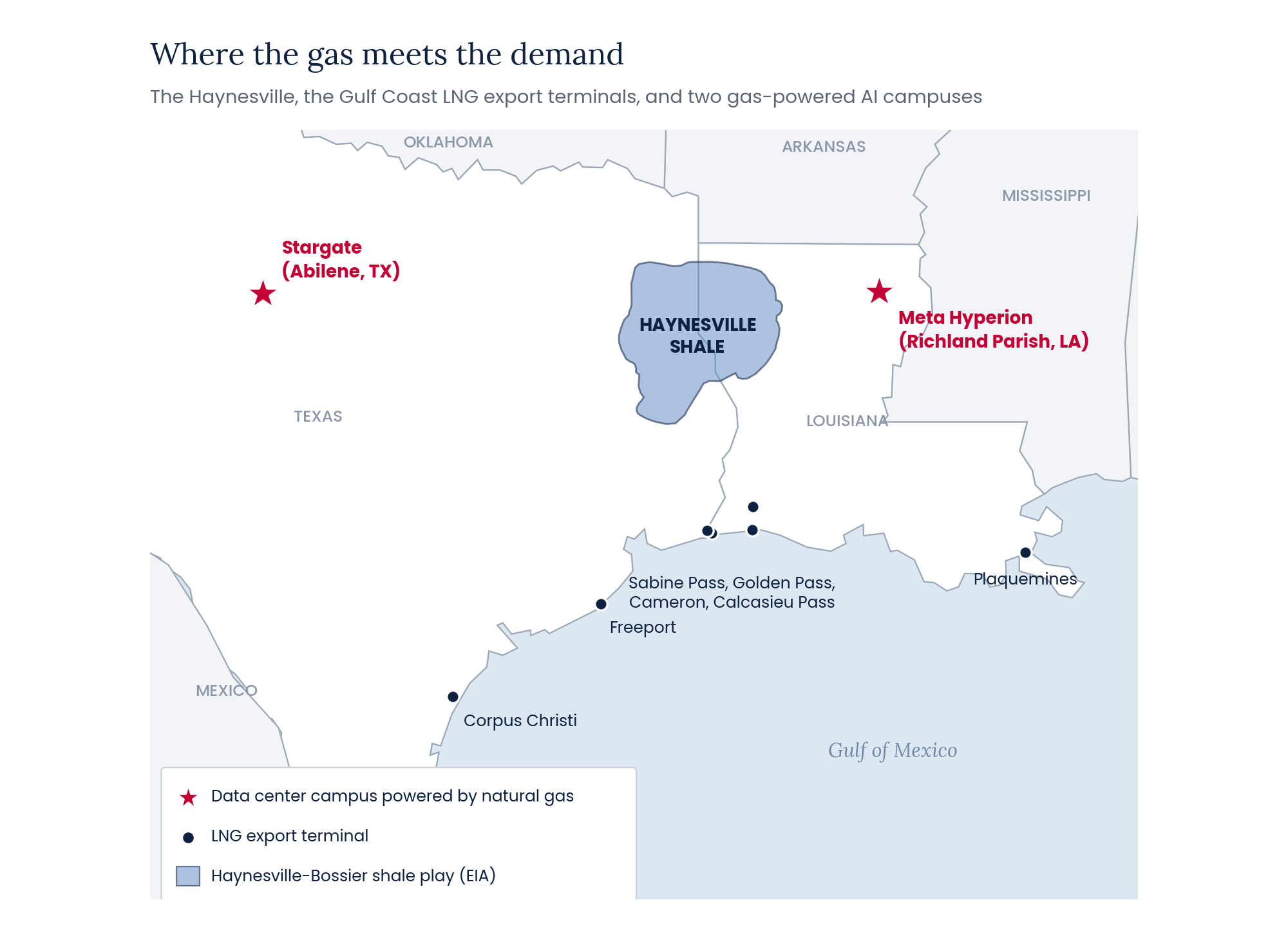
The Haynesville, the Gulf Coast LNG export terminals, and two gas-powered AI campuses. The shaded area is the Haynesville-Bossier shale play. Circles mark the seven operating LNG export terminals along the Texas and Louisiana coast; stars mark Meta's Hyperion campus and the Stargate campus in Abilene. Locations are approximate. Source: EIA shale play boundaries (September 2019 update); terminal and campus locations from company announcements.
If you want to understand where electricity in this country is headed over the next decade, that one project tells you most of it. So I want to walk through what is happening, take the objections seriously, because a lot of them are fair, and then tell you why I think American natural gas is the fuel this whole thing runs on. And, as usual, what an ordinary person can do about it.
For most of my adult life, electricity demand in this country barely moved. Between 2005 and 2019, it grew about 0.1% a year. Efficiency gains ate almost all of the growth. Utilities planned around a flat line, and for fifteen years the flat line was right.
That era is done. Between 2020 and 2025, demand grew about 1.7% a year, and the Energy Information Administration, the federal government's energy statistics agency, says data centers are the main driver. EIA's February forecast called for growth of 1.9% this year and 2.5% next year. That may not sound like much, but on a system the size of ours it is an enormous amount of new power, and it is concentrated in a few places. EIA expects the Texas grid, run by ERCOT, to grow about 10% a year between 2025 and 2027.
A data center is a warehouse full of computers that never turn off. The ones built for artificial intelligence are far more power hungry than the ones that used to store your email and photos. Lawrence Berkeley National Laboratory estimates data centers used about 4.4% of all US electricity in 2023. The Department of Energy says that could reach 12% by 2028. In Virginia, home to the heaviest concentration of data centers in the country, the share already runs above 25%.
And EIA's long-range outlook, published in April, says installed generating capacity in this country could need to nearly double by midcentury.
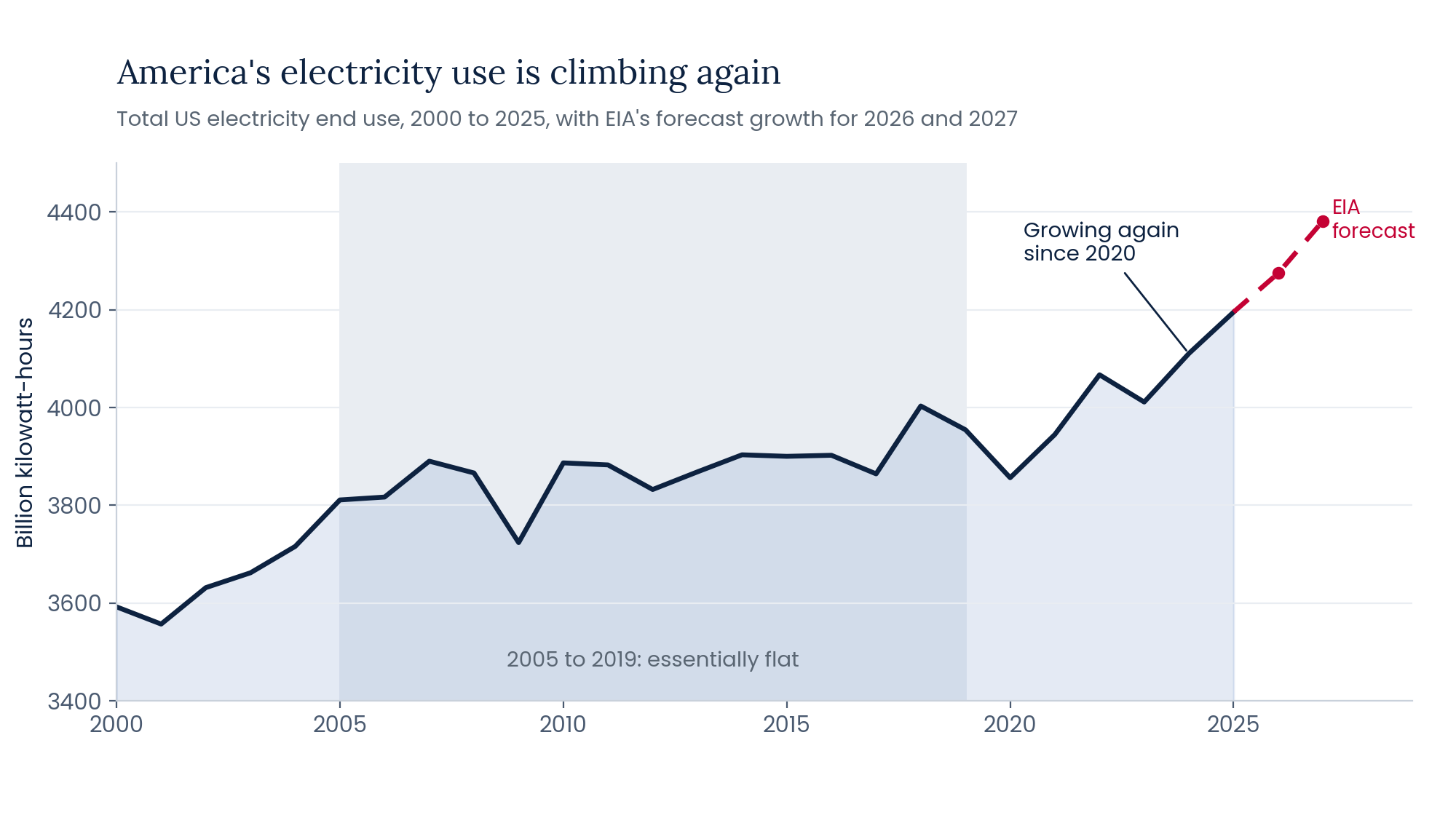
Total US electricity end use, 2000 to 2025. The shaded band marks 2005 to 2019. The dashed red line applies the 2026 and 2027 growth rates in EIA's February 2026 Short-Term Energy Outlook. Source: EIA Monthly Energy Review, Table 7.6 (retail sales plus direct use), and EIA STEO.
That is the demand side. The question everybody is arguing about is what supplies it.
A data center needs power 24 hours a day, 365 days a year. It does not care whether the wind is blowing or the sun is up. Engineers call that "firm" power: electricity you can count on at 3 in the morning in a January cold snap.
Wind and solar are growing fast, and they are going to keep growing. But on their own, neither is firm. Batteries help at the margins and get better every year. Nuclear is firm and clean, and I would love to see more of it, but a new plant takes the better part of a decade and nobody is building one on the timeline these companies need.
Natural gas is firm, it is abundant here, and it can be built in a few years. That is why the people spending the most money on artificial intelligence keep landing on it.
Look at what has already happened:
Meta is paying for those 10 Louisiana gas plants. Entergy, the utility, says the agreement is structured so Meta pays its full cost of service.
The Stargate data center in Abilene, Texas, a joint project of OpenAI, Oracle and SoftBank, is being powered in part by gas turbines built right on site.
And the companies that build the big turbines cannot make them fast enough. GE Vernova, one of three companies that dominate the world's large gas turbine market, reported 100 gigawatts of gas equipment backlog and reserved factory slots at the end of March, up from 83 gigawatts three months earlier. Its CEO has said he expects slots to be sold out through 2030 by the end of this year. Siemens Energy is booking turbine orders at more than twice the rate it can ship them.
When the equipment to burn a fuel is sold out years ahead, the market has told you what it thinks the fuel is worth.
I am an oil and gas guy, and I will tell you straight that the people opposed to data centers are not all cranks. Opposition is real and it is growing fast. A research group called Data Center Watch counted at least 75 projects worth about $130 billion blocked or delayed in the first three months of this year alone, about as much as all of 2025. The number of local opposition groups more than doubled to 833 across 49 states, and they are on both sides of the aisle.
Their concerns come down to four things: power bills, water, noise, and whether the town gets enough out of the deal. Those are reasonable questions from people who live next to these things. This is how I think about each one.
Power bills. If a data center shows up and the utility builds new power plants to serve it, somebody has to pay for those plants. If it is the residential customer, that is a bad deal, and people are right to be angry about it. The answer is to make the data center pay for what it uses and what gets built for it. That is the structure Entergy says it negotiated with Meta. Critics like the Union of Concerned Scientists argue Louisiana ratepayers are still exposed if the demand does not stick around. That is a fair fight, and it should be fought in front of regulators, in public, which is exactly where it is happening. The Louisiana commission is scheduled to rule in December.
Water. This is the one people get most wrong, so let me be specific about where the water goes. A data center uses water in two places. The first is on site, to cool the servers. Berkeley Lab estimates US data centers consumed about 17 billion gallons that way in 2023. The second is at the power plants that make their electricity, and that is where the bulk of it is: about 211 billion gallons, roughly 12 times the on-site number.
Now put that next to something familiar. America's golf courses applied about 1.63 million acre-feet of water in 2024, according to the Golf Course Superintendents Association of America. That works out to about 531 billion gallons. Golf courses put roughly 30 times more water on their turf than data centers consumed cooling their servers. Add in every gallon used at the power plants and data centers still come in at less than half of golf. Nobody is organizing against the back nine.
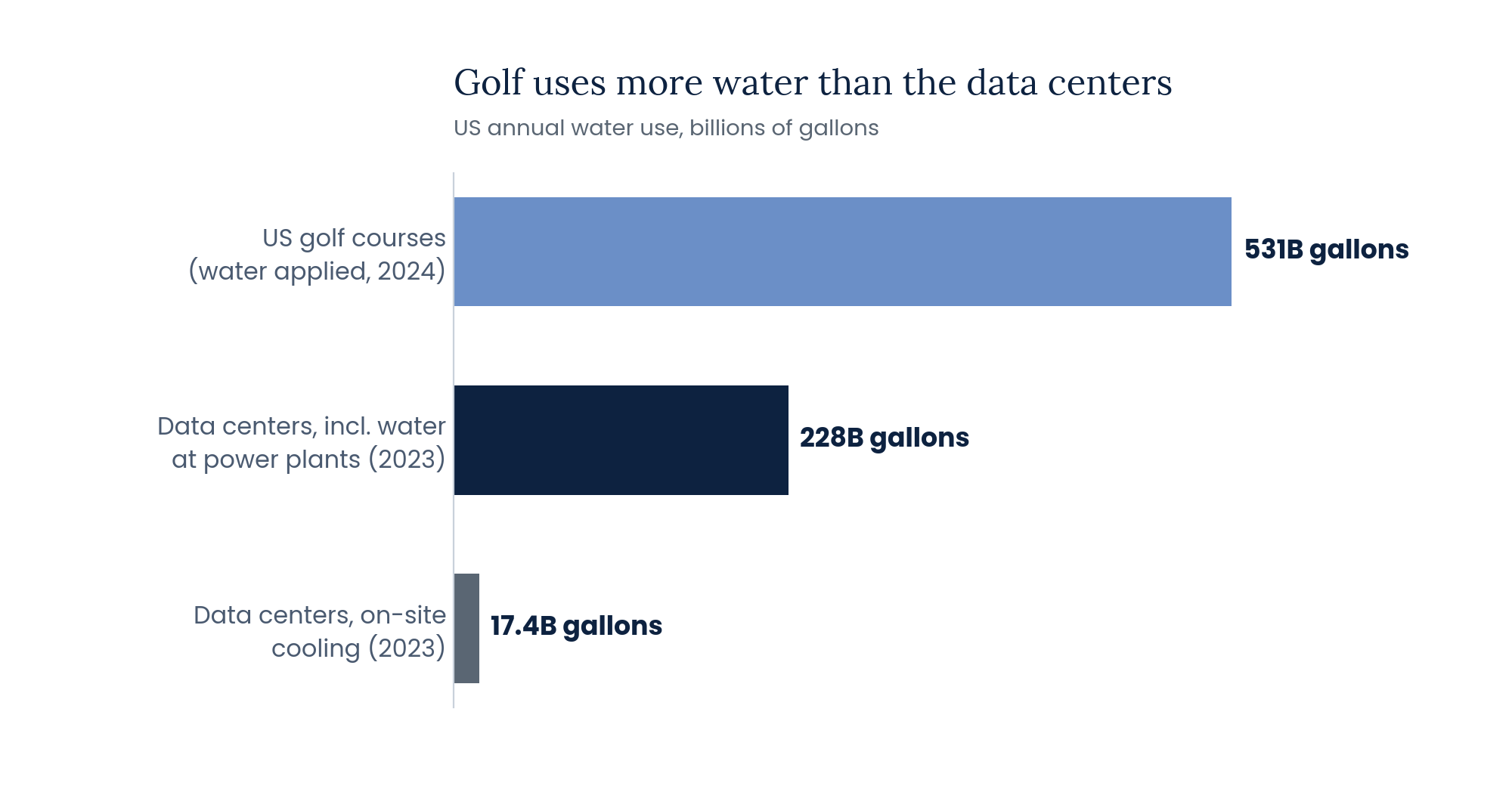
US annual water use, billions of gallons. Golf is water applied to turf in 2024. Data center figures are water consumed in 2023, on site and at the power plants that supplied their electricity. Sources: GCSAA and USGA Golf Course Environmental Profile (December 2025); Lawrence Berkeley National Laboratory, 2024 United States Data Center Energy Usage Report.
And the on-site number is heading toward zero. The newest data centers cool their chips with closed-loop systems, the same idea as the radiator in your truck. The loop is filled once during construction, and the water circulates over and over without evaporating. Microsoft says every data center it has designed since August 2024 uses this approach, and that each one avoids more than 33 million gallons of water a year compared with the old evaporative designs.
The power plant side matters too, and it is a point in favor of modern gas. In a combined-cycle plant, about two-thirds of the power comes from the gas turbine itself, which needs no cooling water at all. Only the steam side needs cooling, and it can be designed to use very little.
Where water deserves a hard look is local. A big campus drawing on a stressed aquifer in the desert is a different conversation than one in north Louisiana, and that is a fair siting question. As a national argument against data centers, water is one of the weakest.
Noise. Real, and mostly a siting and design problem. Turbines and cooling fans make noise. Put them next to a neighborhood without enclosures, setbacks and berms and you will make enemies, and you will deserve to. Put them where they belong and build them right and it is a manageable problem. Every industry I have ever worked in has had to learn this lesson with its neighbors.
The local deal. Hyperion is expected to employ more than 5,000 construction workers at peak and support more than 500 permanent jobs in a parish where about a quarter of residents live below the poverty line. Whether that is enough is for the people of Richland Parish to decide. But it is not nothing.
When I say natural gas is clean burning, I want to be precise, because the phrase gets thrown around.
Natural gas is mostly methane. When you burn it, it produces far less carbon dioxide than coal for the same amount of energy, and almost none of the soot, sulfur and mercury that come out of a coal stack. EIA measured it: in 2019, coal-fired generation in this country produced about 2,257 pounds of carbon dioxide for every megawatt-hour of electricity. Natural gas produced 976. Less than half.
It is also the single biggest reason American power sector emissions fell as much as they did. By 2019, power sector carbon emissions were 32% below 2005 levels, and EIA attributed about 65% of that decline to switching from coal to gas. Mostly, gas got cheaper and won on the merits.
Clean burning does not mean zero. Gas still emits carbon dioxide, and methane that leaks before it gets burned is a serious problem our industry has to keep driving down. Anybody who tells you gas is perfect is selling you something. But if the question is how this country adds a massive amount of firm power in the next five to ten years while keeping emissions in check, gas replacing coal is the most proven answer we have.
The United States leads the world in the chips and the software. Where we are behind is electricity.
A Federal Reserve research note put the numbers side by side. China has roughly 3,200 gigawatts of generating capacity. The United States has about 1,293. And in 2024 alone, China added 429 gigawatts, more than 15 times what we added.
OpenAI has told the White House it thinks this country needs to build about 100 gigawatts of new generation every year to keep up, and it called electricity a strategic asset in the race with China. You can argue with the exact number. You cannot argue with the direction.
The winner of the artificial intelligence race will be the country that can plug in the most computing power, fastest, at a price that makes sense. We are not going to out-build China on solar panels. We are the Saudi Arabia of natural gas, and we should act like it.
This is the part that connects to everything I have been writing about all year.
The war in the Middle East did not just hit oil. About 20% of the world's liquefied natural gas, gas that is chilled into a liquid so it can be shipped by tanker, moved through the Strait of Hormuz, mostly from Qatar. When the strait closed, that supply got trapped, and prices overseas took off. Europe's benchmark gas price averaged $14.74 per million British thermal units in the first half of this year, the highest since Russia invaded Ukraine.
Here at home, our benchmark price at Henry Hub in Louisiana is trading under $3.
Same molecule, a fraction of the price. That gap is a gift. It means American factories, and American data centers, can buy the world's most important fuel for a fraction of what their competitors pay. And it means the rest of the world wants our gas. US exports of liquefied natural gas rose 23% in the first half of this year as new export terminals came online, and EIA expects another record next year.
So the same gas is being pulled in two directions at once: overseas through export terminals on the Gulf Coast, and at home by power plants for data centers. A lot of both of those roads run through Louisiana and Texas, and a lot of the gas that feeds them comes out of the Haynesville.
I will tell you where I think this is heading, and I will tell you where the government currently disagrees with me.
At Basin we spend a lot of time comparing data sets on natural gas: export capacity, power demand, production and storage. When we line them up, the tightest stretch for American gas looks like late 2027 into 2028, and the Haynesville is where we want to be when it arrives.
The first reason is exports. EIA counts about 13.9 Bcf/d of new US liquefaction capacity planned between 2025 and 2029, enough to more than double the country's export capacity. (A Bcf/d is a billion cubic feet of gas per day.) The projects under construction, including Golden Pass, Port Arthur, Rio Grande, Woodside Louisiana and CP2, sit along the Texas and Louisiana coast, and the Haynesville is the closest major gas field to most of them.
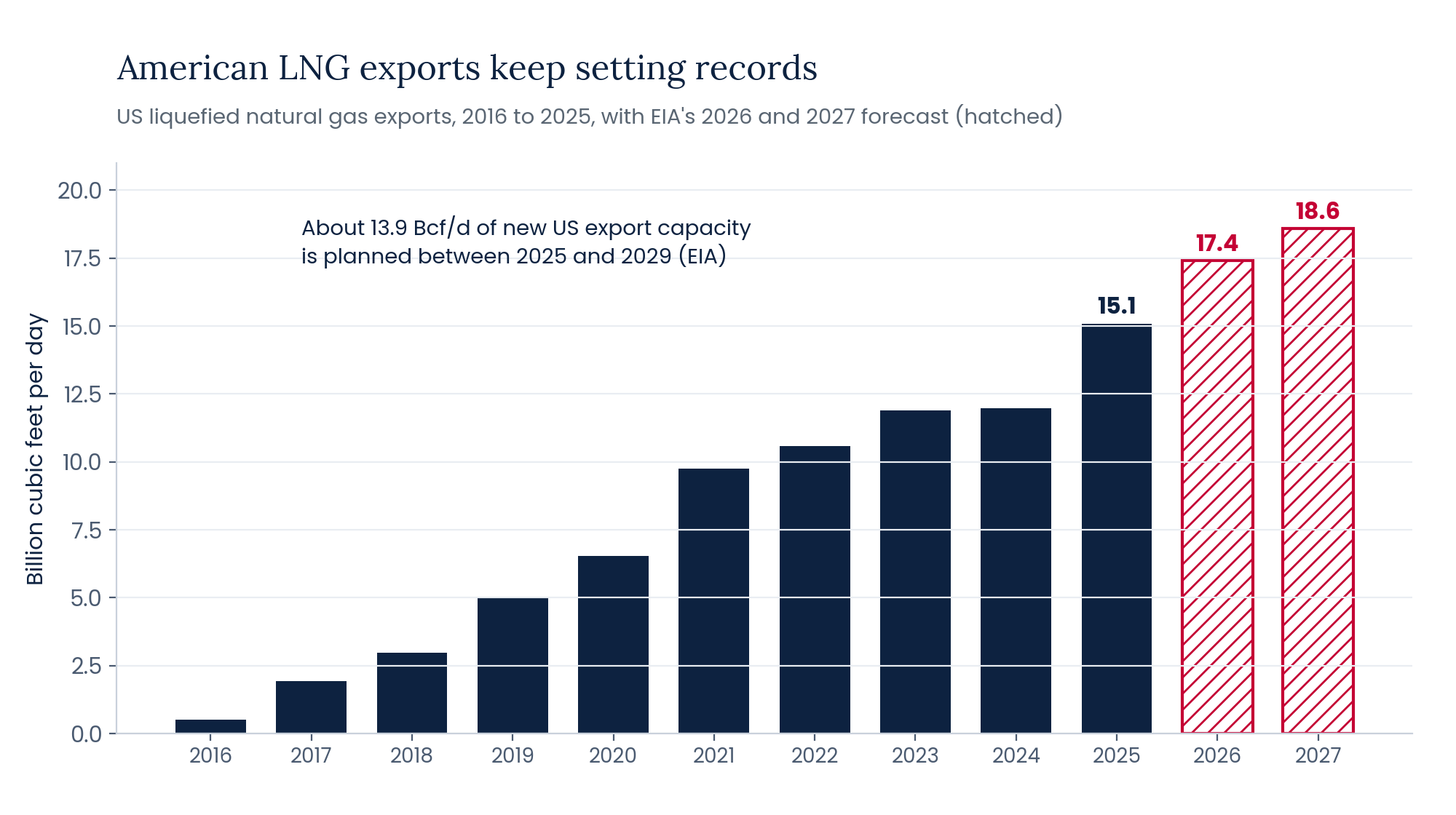
US liquefied natural gas exports, billion cubic feet per day. Solid bars are actual annual exports. Hatched bars are EIA's September 2026 forecast. Sources: EIA natural gas exports series N9133US2; EIA Short-Term Energy Outlook, September 2026; EIA Today in Energy, October 16, 2025.
The second reason is power. The gas turbines being ordered for data centers today are mostly scheduled to arrive at the end of the decade. GE Vernova has been selling factory slots for 2029 and 2030. When those plants come online, they burn gas every hour of every day, and that demand lands on top of the exports.
Even if some of these data centers get slow-played by the opposition I described above, the export terminals are already under construction. That demand is coming either way.
Now the other side. EIA's September forecast has Henry Hub averaging $3.28 in 2027, a little below this year. Production keeps growing faster than expected, led by the Permian, where a big new pipeline started up ahead of schedule, and storage is heading into winter about 5% above normal. Even so, EIA's own numbers have prices climbing through 2027, from about $2.76 in the second quarter to about $3.59 in the fourth. And the forecast moves. In January, the same agency expected a 2027 supply shortfall of 1.6 Bcf/d and a 33% jump in prices. That is natural gas for you.
We do not need to be right on the exact quarter, and we do not underwrite as if we will be. More on that below.
A couple of weeks ago I wrote a piece on this site called "Oil Isn't Inflationary If You Own It." The idea was simple. Every household in America is short energy. You buy it whether you want to or not, and when the price goes up, you pay. Owning production flips that. The same price move that raises your bills raises your revenue.
Electricity is the same story with a different fuel. New power plants and new transmission lines cost money, and a lot of it lands on ratepayers. In Louisiana alone, the Union of Concerned Scientists estimates high data center growth could add $26 billion to the state's electricity system costs over the next 15 years. Whatever you think about data centers, some share of that bill is coming to your house.
You can be mad about that, and you can show up at your utility commission and demand the data center pays its fair share. You should. But you can also own a piece of the fuel.
Natural gas isn't inflationary if you own it either.
Now the honest part. Gas prices are volatile, often more than oil. Henry Hub hit an all-time high in January during Winter Storm Fern, then fell back below last year's levels by February. A lot of people have lost money betting on the next gas boom being right around the corner. Nobody should own natural gas production because they think prices are about to double. You own it because the long-term demand is real and building, because this country has the resource to meet it, and because you would rather be on the receiving end of the bill than the paying end.
I run an oil and gas investment firm, so weigh what follows accordingly.
Basin Ventures buys non-operated working interests. That means a direct ownership stake in producing wells, drilled and run by established operators, most of them publicly traded companies you have likely heard of. We underwrite the geology, the operator and the economics, and our investors own a share of the production and the revenue. Our job is to pick the right rock, with the right operator, at the right price. If you are new to how that works, we wrote a beginner's guide to non-operated working interests that walks through it.
Fund V is open now. It already owns a position in the Haynesville producing dry natural gas, the same field that sits just west of Hyperion and feeds the Gulf Coast export terminals. It also holds a position in the Anadarko Basin producing oil, natural gas, and natural gas liquids. We are reviewing projects across the country and intend to be opportunistic as we round out the fund.
A small move in gas prices is a big move in a gas well's revenue. The industry converts gas to oil on energy content at roughly 6,000 cubic feet per barrel, so a $1 move in the price of a thousand cubic feet of gas is worth about $6 per barrel of oil equivalent. On $3 gas, that dollar is a 33% change in what the well brings in, the same as oil moving from $65 to about $87. Our funds own gas-weighted wells in Louisiana, Oklahoma and Texas, so a move of a dollar or so in gas is material for our investors. It cuts both ways, which is exactly why we underwrite the way we do.
One thing I want understood. We do not underwrite deals to a data center boom, the same way we do not underwrite oil deals to $100 Brent. Our models run on conservative long-term price assumptions. If the demand story plays out the way I think it will, that is upside for the investors in the fund, not an assumption we need to be right about.
The same caveats I always give apply here. Producing wells decline, so a position has to be replenished over time. What a well earns is not the headline price you see on the news. Local prices differ from Henry Hub, sometimes by a lot, and that difference, called basis, can move against you. And gas prices can fall for long stretches. Those are the reasons operator selection and diversification across basins matter more than having a view on price.
The tax treatment of direct drilling investments is also worth a conversation with your tax advisor. The short version is that drilling costs have long been deductible, and recent changes to bonus depreciation expanded what can be expensed in the first year. We have written about intangible drilling costs in detail on this site. How any of that applies to you depends entirely on your own situation.
Electricity demand in this country is growing again for the first time in a generation, and artificial intelligence is the biggest reason. The companies building it need firm power, fast, and they keep choosing natural gas, to the point that the turbines are sold out for years. The objections from neighbors are fair and should be answered with good siting, good engineering and a rule that the data center pays its own way. The answer to those objections is to build it right.
We have the gas. We have it at a fraction of what the rest of the world pays. And the country that powers the most computing will win this race.
The AI race is going to run up a power bill for this entire country. I would rather own some of what it burns.
I write about this kind of thing all the time. I try to stay on top of whatever is moving energy markets so the people who read and follow me are as informed as they can be. You can find me at @TheTXOilMan on X and Instagram, and as Adam W. Butcher on LinkedIn and Facebook.
To learn more about Basin Ventures and Fund V, visit basinventures.com.



In a rural corner of northeast Louisiana called Richland Parish, Meta is building the largest data center it has ever attempted. It is called Hyperion. And to keep the lights on, the local utility plans to build it 10 natural gas power plants.
Ten. With roughly 7.5 gigawatts of capacity between them, which is more than a 30% increase to the entire state of Louisiana's grid. Fortune put it at enough power for more than 5 million homes, all of it pointed at one campus full of computer servers.
The site sits within about 80 miles of the Haynesville Shale, the third-largest natural gas producing region in the country.
The Haynesville, the Gulf Coast LNG export terminals, and two gas-powered AI campuses. The shaded area is the Haynesville-Bossier shale play. Circles mark the seven operating LNG export terminals along the Texas and Louisiana coast; stars mark Meta's Hyperion campus and the Stargate campus in Abilene. Locations are approximate. Source: EIA shale play boundaries (September 2019 update); terminal and campus locations from company announcements.
If you want to understand where electricity in this country is headed over the next decade, that one project tells you most of it. So I want to walk through what is happening, take the objections seriously, because a lot of them are fair, and then tell you why I think American natural gas is the fuel this whole thing runs on. And, as usual, what an ordinary person can do about it.
For most of my adult life, electricity demand in this country barely moved. Between 2005 and 2019, it grew about 0.1% a year. Efficiency gains ate almost all of the growth. Utilities planned around a flat line, and for fifteen years the flat line was right.
That era is done. Between 2020 and 2025, demand grew about 1.7% a year, and the Energy Information Administration, the federal government's energy statistics agency, says data centers are the main driver. EIA's February forecast called for growth of 1.9% this year and 2.5% next year. That may not sound like much, but on a system the size of ours it is an enormous amount of new power, and it is concentrated in a few places. EIA expects the Texas grid, run by ERCOT, to grow about 10% a year between 2025 and 2027.
A data center is a warehouse full of computers that never turn off. The ones built for artificial intelligence are far more power hungry than the ones that used to store your email and photos. Lawrence Berkeley National Laboratory estimates data centers used about 4.4% of all US electricity in 2023. The Department of Energy says that could reach 12% by 2028. In Virginia, home to the heaviest concentration of data centers in the country, the share already runs above 25%.
And EIA's long-range outlook, published in April, says installed generating capacity in this country could need to nearly double by midcentury.
Total US electricity end use, 2000 to 2025. The shaded band marks 2005 to 2019. The dashed red line applies the 2026 and 2027 growth rates in EIA's February 2026 Short-Term Energy Outlook. Source: EIA Monthly Energy Review, Table 7.6 (retail sales plus direct use), and EIA STEO.
That is the demand side. The question everybody is arguing about is what supplies it.
A data center needs power 24 hours a day, 365 days a year. It does not care whether the wind is blowing or the sun is up. Engineers call that "firm" power: electricity you can count on at 3 in the morning in a January cold snap.
Wind and solar are growing fast, and they are going to keep growing. But on their own, neither is firm. Batteries help at the margins and get better every year. Nuclear is firm and clean, and I would love to see more of it, but a new plant takes the better part of a decade and nobody is building one on the timeline these companies need.
Natural gas is firm, it is abundant here, and it can be built in a few years. That is why the people spending the most money on artificial intelligence keep landing on it.
Look at what has already happened:
Meta is paying for those 10 Louisiana gas plants. Entergy, the utility, says the agreement is structured so Meta pays its full cost of service.
The Stargate data center in Abilene, Texas, a joint project of OpenAI, Oracle and SoftBank, is being powered in part by gas turbines built right on site.
And the companies that build the big turbines cannot make them fast enough. GE Vernova, one of three companies that dominate the world's large gas turbine market, reported 100 gigawatts of gas equipment backlog and reserved factory slots at the end of March, up from 83 gigawatts three months earlier. Its CEO has said he expects slots to be sold out through 2030 by the end of this year. Siemens Energy is booking turbine orders at more than twice the rate it can ship them.
When the equipment to burn a fuel is sold out years ahead, the market has told you what it thinks the fuel is worth.
I am an oil and gas guy, and I will tell you straight that the people opposed to data centers are not all cranks. Opposition is real and it is growing fast. A research group called Data Center Watch counted at least 75 projects worth about $130 billion blocked or delayed in the first three months of this year alone, about as much as all of 2025. The number of local opposition groups more than doubled to 833 across 49 states, and they are on both sides of the aisle.
Their concerns come down to four things: power bills, water, noise, and whether the town gets enough out of the deal. Those are reasonable questions from people who live next to these things. This is how I think about each one.
Power bills. If a data center shows up and the utility builds new power plants to serve it, somebody has to pay for those plants. If it is the residential customer, that is a bad deal, and people are right to be angry about it. The answer is to make the data center pay for what it uses and what gets built for it. That is the structure Entergy says it negotiated with Meta. Critics like the Union of Concerned Scientists argue Louisiana ratepayers are still exposed if the demand does not stick around. That is a fair fight, and it should be fought in front of regulators, in public, which is exactly where it is happening. The Louisiana commission is scheduled to rule in December.
Water. This is the one people get most wrong, so let me be specific about where the water goes. A data center uses water in two places. The first is on site, to cool the servers. Berkeley Lab estimates US data centers consumed about 17 billion gallons that way in 2023. The second is at the power plants that make their electricity, and that is where the bulk of it is: about 211 billion gallons, roughly 12 times the on-site number.
Now put that next to something familiar. America's golf courses applied about 1.63 million acre-feet of water in 2024, according to the Golf Course Superintendents Association of America. That works out to about 531 billion gallons. Golf courses put roughly 30 times more water on their turf than data centers consumed cooling their servers. Add in every gallon used at the power plants and data centers still come in at less than half of golf. Nobody is organizing against the back nine.
US annual water use, billions of gallons. Golf is water applied to turf in 2024. Data center figures are water consumed in 2023, on site and at the power plants that supplied their electricity. Sources: GCSAA and USGA Golf Course Environmental Profile (December 2025); Lawrence Berkeley National Laboratory, 2024 United States Data Center Energy Usage Report.
And the on-site number is heading toward zero. The newest data centers cool their chips with closed-loop systems, the same idea as the radiator in your truck. The loop is filled once during construction, and the water circulates over and over without evaporating. Microsoft says every data center it has designed since August 2024 uses this approach, and that each one avoids more than 33 million gallons of water a year compared with the old evaporative designs.
The power plant side matters too, and it is a point in favor of modern gas. In a combined-cycle plant, about two-thirds of the power comes from the gas turbine itself, which needs no cooling water at all. Only the steam side needs cooling, and it can be designed to use very little.
Where water deserves a hard look is local. A big campus drawing on a stressed aquifer in the desert is a different conversation than one in north Louisiana, and that is a fair siting question. As a national argument against data centers, water is one of the weakest.
Noise. Real, and mostly a siting and design problem. Turbines and cooling fans make noise. Put them next to a neighborhood without enclosures, setbacks and berms and you will make enemies, and you will deserve to. Put them where they belong and build them right and it is a manageable problem. Every industry I have ever worked in has had to learn this lesson with its neighbors.
The local deal. Hyperion is expected to employ more than 5,000 construction workers at peak and support more than 500 permanent jobs in a parish where about a quarter of residents live below the poverty line. Whether that is enough is for the people of Richland Parish to decide. But it is not nothing.
When I say natural gas is clean burning, I want to be precise, because the phrase gets thrown around.
Natural gas is mostly methane. When you burn it, it produces far less carbon dioxide than coal for the same amount of energy, and almost none of the soot, sulfur and mercury that come out of a coal stack. EIA measured it: in 2019, coal-fired generation in this country produced about 2,257 pounds of carbon dioxide for every megawatt-hour of electricity. Natural gas produced 976. Less than half.
It is also the single biggest reason American power sector emissions fell as much as they did. By 2019, power sector carbon emissions were 32% below 2005 levels, and EIA attributed about 65% of that decline to switching from coal to gas. Mostly, gas got cheaper and won on the merits.
Clean burning does not mean zero. Gas still emits carbon dioxide, and methane that leaks before it gets burned is a serious problem our industry has to keep driving down. Anybody who tells you gas is perfect is selling you something. But if the question is how this country adds a massive amount of firm power in the next five to ten years while keeping emissions in check, gas replacing coal is the most proven answer we have.
The United States leads the world in the chips and the software. Where we are behind is electricity.
A Federal Reserve research note put the numbers side by side. China has roughly 3,200 gigawatts of generating capacity. The United States has about 1,293. And in 2024 alone, China added 429 gigawatts, more than 15 times what we added.
OpenAI has told the White House it thinks this country needs to build about 100 gigawatts of new generation every year to keep up, and it called electricity a strategic asset in the race with China. You can argue with the exact number. You cannot argue with the direction.
The winner of the artificial intelligence race will be the country that can plug in the most computing power, fastest, at a price that makes sense. We are not going to out-build China on solar panels. We are the Saudi Arabia of natural gas, and we should act like it.
This is the part that connects to everything I have been writing about all year.
The war in the Middle East did not just hit oil. About 20% of the world's liquefied natural gas, gas that is chilled into a liquid so it can be shipped by tanker, moved through the Strait of Hormuz, mostly from Qatar. When the strait closed, that supply got trapped, and prices overseas took off. Europe's benchmark gas price averaged $14.74 per million British thermal units in the first half of this year, the highest since Russia invaded Ukraine.
Here at home, our benchmark price at Henry Hub in Louisiana is trading under $3.
Same molecule, a fraction of the price. That gap is a gift. It means American factories, and American data centers, can buy the world's most important fuel for a fraction of what their competitors pay. And it means the rest of the world wants our gas. US exports of liquefied natural gas rose 23% in the first half of this year as new export terminals came online, and EIA expects another record next year.
So the same gas is being pulled in two directions at once: overseas through export terminals on the Gulf Coast, and at home by power plants for data centers. A lot of both of those roads run through Louisiana and Texas, and a lot of the gas that feeds them comes out of the Haynesville.
I will tell you where I think this is heading, and I will tell you where the government currently disagrees with me.
At Basin we spend a lot of time comparing data sets on natural gas: export capacity, power demand, production and storage. When we line them up, the tightest stretch for American gas looks like late 2027 into 2028, and the Haynesville is where we want to be when it arrives.
The first reason is exports. EIA counts about 13.9 Bcf/d of new US liquefaction capacity planned between 2025 and 2029, enough to more than double the country's export capacity. (A Bcf/d is a billion cubic feet of gas per day.) The projects under construction, including Golden Pass, Port Arthur, Rio Grande, Woodside Louisiana and CP2, sit along the Texas and Louisiana coast, and the Haynesville is the closest major gas field to most of them.
US liquefied natural gas exports, billion cubic feet per day. Solid bars are actual annual exports. Hatched bars are EIA's September 2026 forecast. Sources: EIA natural gas exports series N9133US2; EIA Short-Term Energy Outlook, September 2026; EIA Today in Energy, October 16, 2025.
The second reason is power. The gas turbines being ordered for data centers today are mostly scheduled to arrive at the end of the decade. GE Vernova has been selling factory slots for 2029 and 2030. When those plants come online, they burn gas every hour of every day, and that demand lands on top of the exports.
Even if some of these data centers get slow-played by the opposition I described above, the export terminals are already under construction. That demand is coming either way.
Now the other side. EIA's September forecast has Henry Hub averaging $3.28 in 2027, a little below this year. Production keeps growing faster than expected, led by the Permian, where a big new pipeline started up ahead of schedule, and storage is heading into winter about 5% above normal. Even so, EIA's own numbers have prices climbing through 2027, from about $2.76 in the second quarter to about $3.59 in the fourth. And the forecast moves. In January, the same agency expected a 2027 supply shortfall of 1.6 Bcf/d and a 33% jump in prices. That is natural gas for you.
We do not need to be right on the exact quarter, and we do not underwrite as if we will be. More on that below.
A couple of weeks ago I wrote a piece on this site called "Oil Isn't Inflationary If You Own It." The idea was simple. Every household in America is short energy. You buy it whether you want to or not, and when the price goes up, you pay. Owning production flips that. The same price move that raises your bills raises your revenue.
Electricity is the same story with a different fuel. New power plants and new transmission lines cost money, and a lot of it lands on ratepayers. In Louisiana alone, the Union of Concerned Scientists estimates high data center growth could add $26 billion to the state's electricity system costs over the next 15 years. Whatever you think about data centers, some share of that bill is coming to your house.
You can be mad about that, and you can show up at your utility commission and demand the data center pays its fair share. You should. But you can also own a piece of the fuel.
Natural gas isn't inflationary if you own it either.
Now the honest part. Gas prices are volatile, often more than oil. Henry Hub hit an all-time high in January during Winter Storm Fern, then fell back below last year's levels by February. A lot of people have lost money betting on the next gas boom being right around the corner. Nobody should own natural gas production because they think prices are about to double. You own it because the long-term demand is real and building, because this country has the resource to meet it, and because you would rather be on the receiving end of the bill than the paying end.
I run an oil and gas investment firm, so weigh what follows accordingly.
Basin Ventures buys non-operated working interests. That means a direct ownership stake in producing wells, drilled and run by established operators, most of them publicly traded companies you have likely heard of. We underwrite the geology, the operator and the economics, and our investors own a share of the production and the revenue. Our job is to pick the right rock, with the right operator, at the right price. If you are new to how that works, we wrote a beginner's guide to non-operated working interests that walks through it.
Fund V is open now. It already owns a position in the Haynesville producing dry natural gas, the same field that sits just west of Hyperion and feeds the Gulf Coast export terminals. It also holds a position in the Anadarko Basin producing oil, natural gas, and natural gas liquids. We are reviewing projects across the country and intend to be opportunistic as we round out the fund.
A small move in gas prices is a big move in a gas well's revenue. The industry converts gas to oil on energy content at roughly 6,000 cubic feet per barrel, so a $1 move in the price of a thousand cubic feet of gas is worth about $6 per barrel of oil equivalent. On $3 gas, that dollar is a 33% change in what the well brings in, the same as oil moving from $65 to about $87. Our funds own gas-weighted wells in Louisiana, Oklahoma and Texas, so a move of a dollar or so in gas is material for our investors. It cuts both ways, which is exactly why we underwrite the way we do.
One thing I want understood. We do not underwrite deals to a data center boom, the same way we do not underwrite oil deals to $100 Brent. Our models run on conservative long-term price assumptions. If the demand story plays out the way I think it will, that is upside for the investors in the fund, not an assumption we need to be right about.
The same caveats I always give apply here. Producing wells decline, so a position has to be replenished over time. What a well earns is not the headline price you see on the news. Local prices differ from Henry Hub, sometimes by a lot, and that difference, called basis, can move against you. And gas prices can fall for long stretches. Those are the reasons operator selection and diversification across basins matter more than having a view on price.
The tax treatment of direct drilling investments is also worth a conversation with your tax advisor. The short version is that drilling costs have long been deductible, and recent changes to bonus depreciation expanded what can be expensed in the first year. We have written about intangible drilling costs in detail on this site. How any of that applies to you depends entirely on your own situation.
Electricity demand in this country is growing again for the first time in a generation, and artificial intelligence is the biggest reason. The companies building it need firm power, fast, and they keep choosing natural gas, to the point that the turbines are sold out for years. The objections from neighbors are fair and should be answered with good siting, good engineering and a rule that the data center pays its own way. The answer to those objections is to build it right.
We have the gas. We have it at a fraction of what the rest of the world pays. And the country that powers the most computing will win this race.
The AI race is going to run up a power bill for this entire country. I would rather own some of what it burns.
I write about this kind of thing all the time. I try to stay on top of whatever is moving energy markets so the people who read and follow me are as informed as they can be. You can find me at @TheTXOilMan on X and Instagram, and as Adam W. Butcher on LinkedIn and Facebook.
To learn more about Basin Ventures and Fund V, visit basinventures.com.

© Copyright 2026 Basin Ventures II, LLC. All right reserved.